
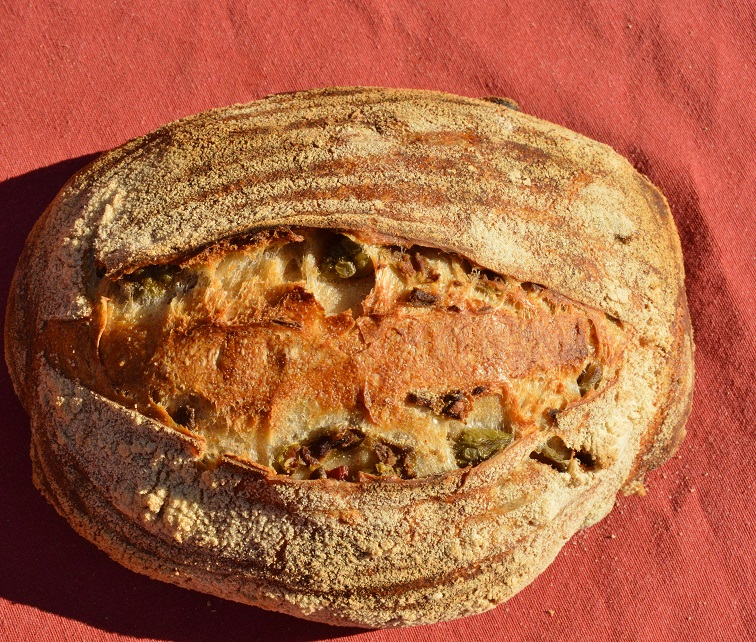
My weekly ritual of making at least a couple of sourdough loaves always fills me with excitement…..not to mention an almost uncontrollable urge to slice into the freshly baked bread!
Updated March 2020: new photos
Costing pennies to make – a far cry from those very expensive sourdough loaves you can buy – and much tastier, it really is not that difficult to make a decent sourdough loaves, once you have a starter.

How to make and handle sourdough
My post on sourdoughs, detailing how to make and maintain a starter, as well as guidelines for handling the dough, shaping and scoring is here.
As with most of my sourdoughs, I feed the starter the morning I want to make the dough and then early evening I make up the dough: a rough timeline is on my post linked about.
About this recipe
This is a fairly standard sourdough recipe, with just a few easy changes to the basic sourdough recipe given at my recipe link above:
- a mixture of ale and water
- a blend of strong white plain flour and wholemeal flour
I used the “stretch and fold” method (detailed in the recipe), but this does, of course, work well with kneading if you prefer that.
Recipe: green olive & rye sourdough: makes 2
- 700g strong plain white flour
- 100g rye flour
- 90g active starter, having been fed earlier in the day (or 90g levain from 10g starter, 40g water, 40g flour)
- 200ml ale
- 330ml cool water
- 12g fine salt
- about 200g green olives, pitted
(1) Add all the ingredients – apart from the olives – to the bowl and make up the dough as in the recipe here until the bulk fermentation has taken place.
(2) Turn out the dough onto a surface that has been lightly dusted with flour. Cut in two equal pieces and gently pat out into two rectangles.

(3) Scatter about 100g chopped green olives over each piece of dough and lightly pat onto the dough so they stick to it.
(4) Roll up the dough, aiming to get surface tension (see recipe link above) and pop them into bannetons that have been dusted liberally with either rice flour or fine semolina.
(5) Cover each and leave at room temperature for an hour to two to “bounce back” in volume a little.

(6) Transfer the bannetons to the fridge for between 6 and 24 or so hours.
(7) Towards the end of this time preheat the oven to its highest setting and place a solid baking tray/griddle pan near the top of the oven (for the dough to bake on later) and a solid tray near the bottom of the oven (to create steam later).
(8) When the oven has come to temperature, turn the dough out onto the hot baking trays and score it with a sharp blade.
(9) Place a mug of water or a few handfuls of ice onto the solid tray near the bottom of the oven – or pop in a Dutch oven. Bake for about 10 minutes at this temperature before turning the oven down to 220C for a further 30-40 minutes until it is as dark as you like it.
NB: the guidelines for turning out and baking are as in my “making sourdoughs” post linked above.


 Phil's Home Kitchen
I wonder if this might be an appropriate time to confess – I think I’ve managed to kill off my starter – it was doing so well …..
LikeLike
Oh no: shockingly murderous! Although discard all but a couple of tablespoons and mix 100g each flour and water. Then following day, discard half and repeat: it may well be ressurected….
But I can give you like some more starter if that doesn’t work
LikeLike