
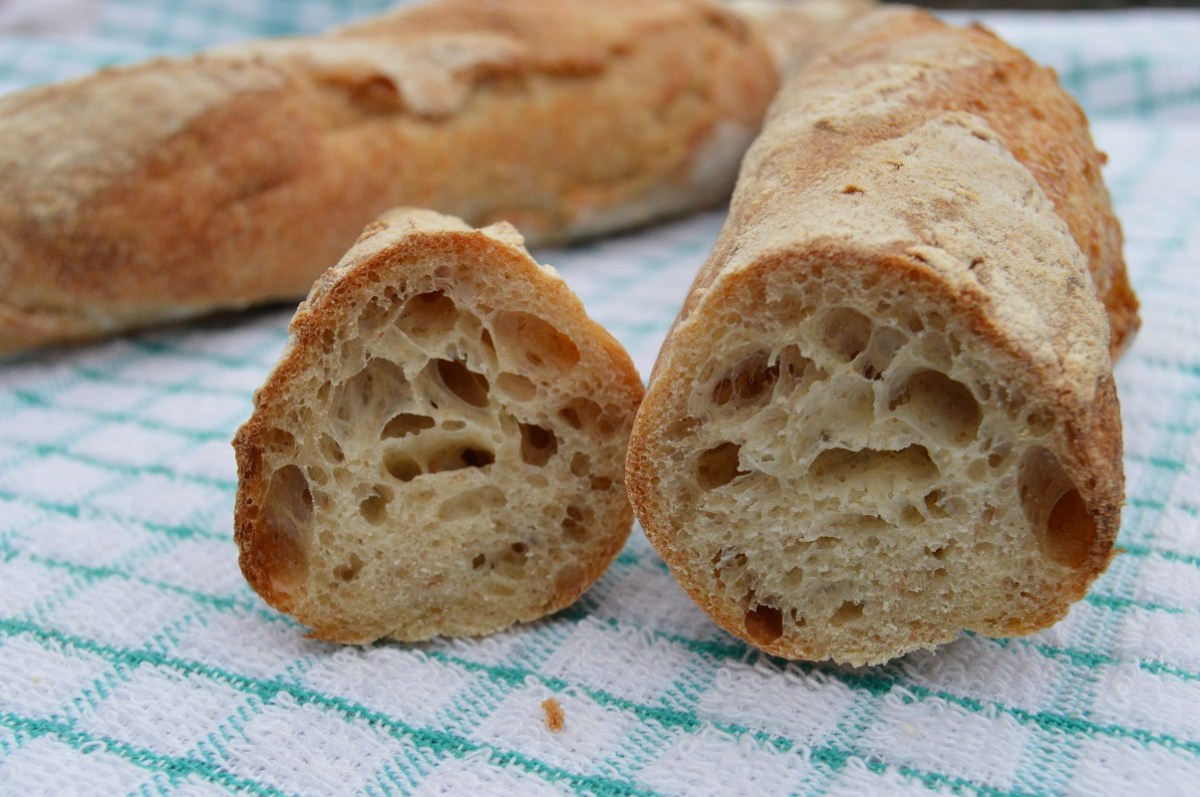
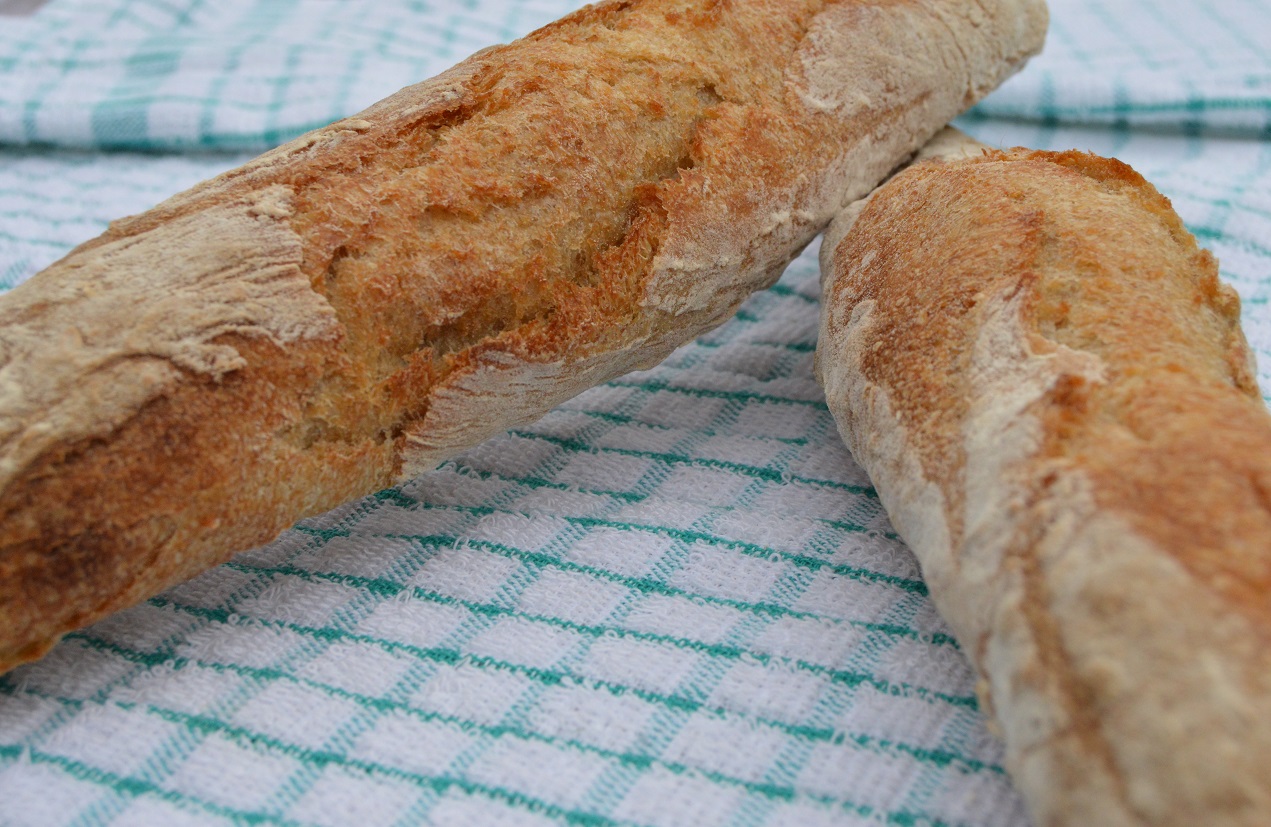
If you want shatteringly crisp baguettes with depth of flavour and an open crumb, this will tick all those boxes. This is a real artisanal bread and is a joy because of its lack of fuss!

These baguettes, based closely on a recipe by Anis Bouabsa, are a joy: a crunchy crust, a soft aerated interior and a rich, almost creamy flavour with a slight natural sweetness. There are real complexities of flavour here – a far cry from using a standard bread dough shaped into baguettes!

This dough uses very little yeast (a mere 1/4 teaspoon dried yeast per 500g flour, which is 0.6g if you have microscales!) but don’t worry about the tiny amount of yeast – it really works! And the very slow fermentation in the fridge does wonders for the flavour of the final bread.
I’ve adapted the recipe to incorporate wholemeal flour and I have slightly increased the water content.
The approach: stretching & folding
This method goes for short bursts of stretching and folding, to give a better, open bread structure. You essentially grab a handful of the dough and pull it until it almost pulls apart from the main bulk of the dough. You then fold it back over the main bulk of the dough before rotating the bowl, grabbing another handful and repeating, for about a minute.
You then leave the dough to rest for about 20 minutes before repeating this process 3-4 more times, ending up with a very soft, shiny dough that has a light, bouncy and almost marshmallow-like texture.
The stretching and folding develops the gluten noticeably with subsequent bursts of stretches and folds, and is a great way to deal with a dough that contains a high level of water.
It might seem a bit of a pain with all the stretching and folding, but it is incredibly easy; the results really do speak for themselves. If you like bread then you have got to make these baguettes.

Shaping
There are several ways to shape the dough once you have split it into the four pieces. The way I mostly do it is:
- pat a piece of dough into a rough rectangle on a very lightly floured surface: aim for a couple of inches wide and its length a few inches shorter than the length of the baguette tray. Try not to knock out too much of the air but don’t worry too much as the dough will prove more after shaping.
- lightly fold one of the longer edges of dough onto the middle to give a rough cylinder. You can repeat with the other longer edge if possible.
- roll the dough over to have the seam underneath
- ideally as you roll it over, apply a little pressure towards the ends so that they taper a little, but this is not essential
- lift onto baguette trays lined with parchment or cloth couches
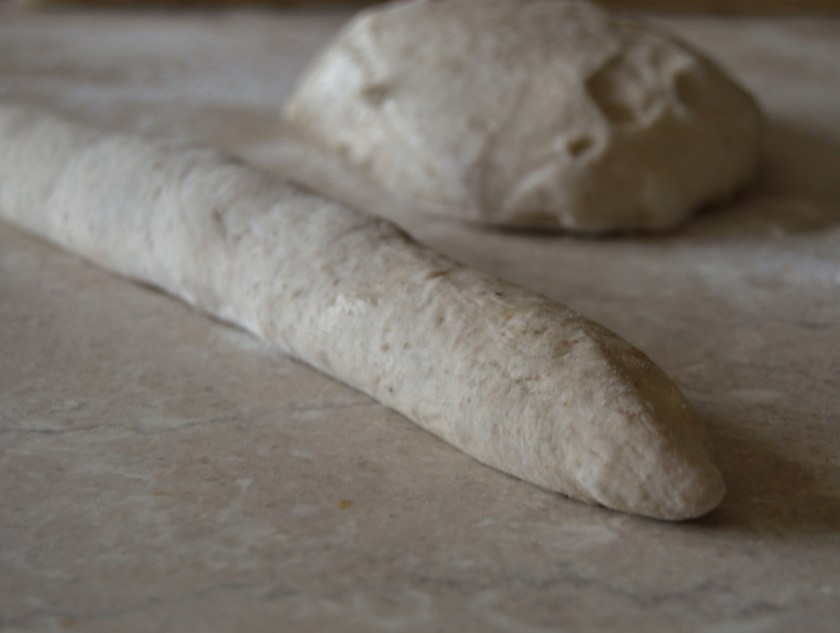
baguettes shaped: tapered ends

Alternatively, just stretch out each piece of dough to a rough cylinder and lift onto the baguette trays.
Baguette trays
I usually bake these baguettes on perforated metal baguette trays rather than cloth couches. I place a strip of non-stick greaseproof along the trays, though, just to prevent any chance of the baguettes from sticking to the trays when they bake, but a good dredging of rice flour also helps prevent sticking.

Scoring:
The scoring/slashing of the dough not only makes the baked baguettes look appealing, it helps control the expansion of the dough in the oven.
Without the scoring – and it is not essential here – the dough will bulge up in the oven and rupture in random places: which I actually quite like!

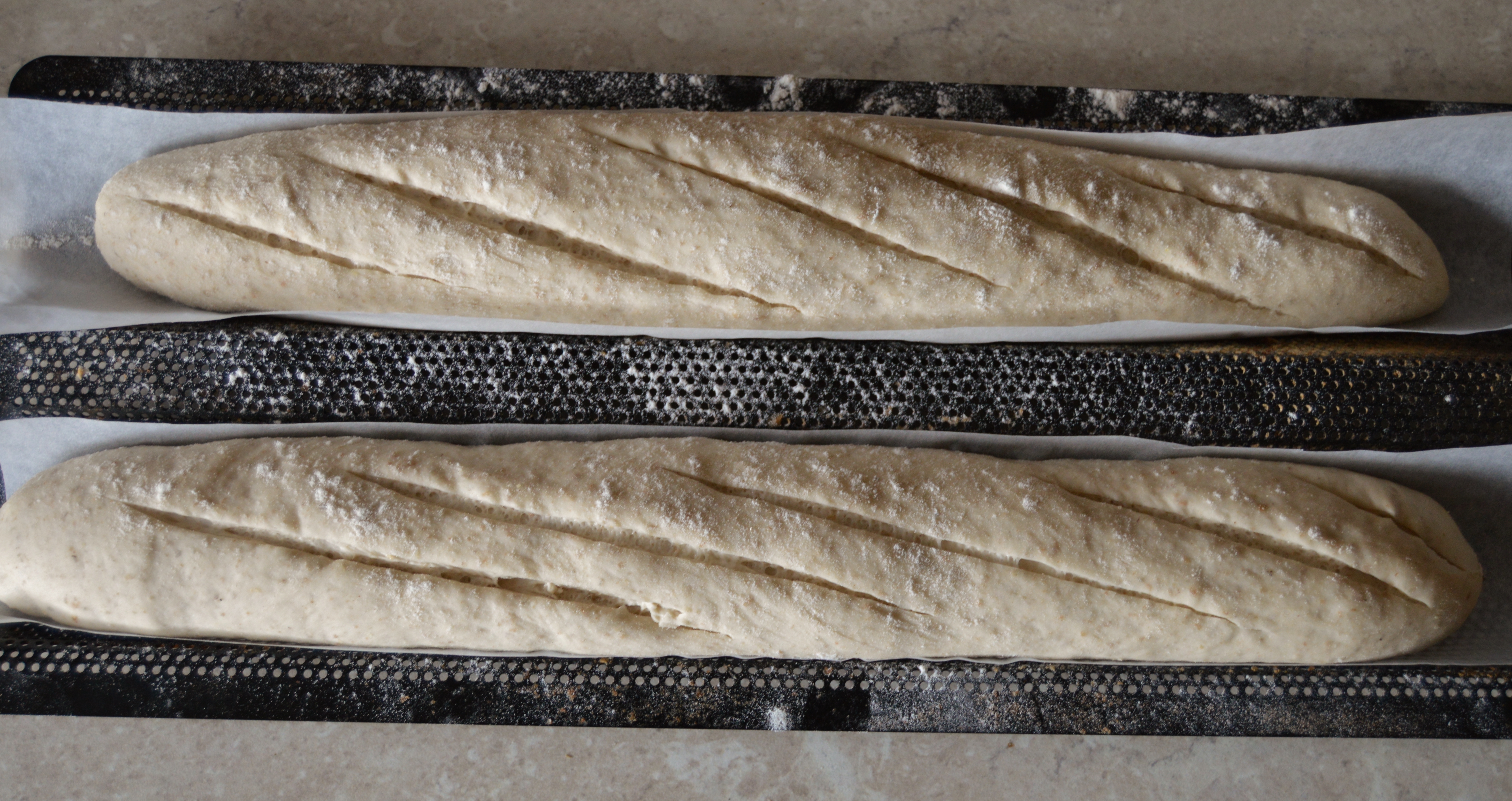
You need a very sharp, clean blade for scoring and a light dusting of flour on the dough: a razor blade is ideal. As the dough is quite soft, owing to the high water content, it can be something of a challenge to score successfully without tearing the dough apart and collapsing it a little, but to be honest, if the cuts are not as clean as they should be, or if the dough tears a little, then fear not: the baguettes will still be magnificent.
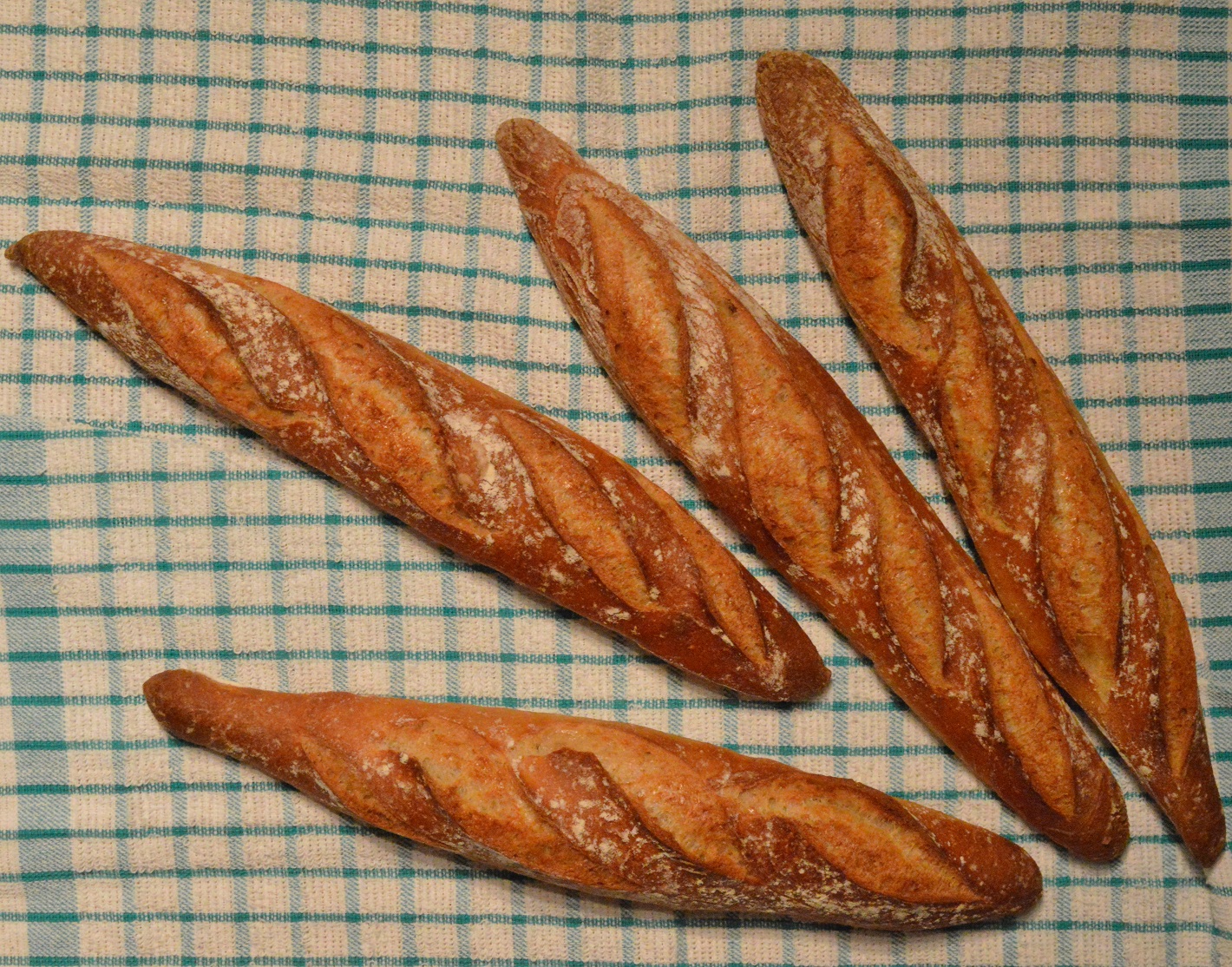
It is important to be quick with the blade: don’t even think about it – just slash and bake. Even better if you can make long parallel slashes on the diagonal, slightly overlapping (as in the photo below)
Recipe: baguettes (makes 4)
- 420g strong white bread flour
- 80g wholemeal flour
- 1/4 teaspoon or 0.6g dried instant yeast (honestly, you only need this small amount!)
- 10g fine sea salt
- 390ml water (you can get away with about 350ml if you want a firmer dough, but the baguettes will not be as light inside)
You will also need a little extra flour (or rice flour or fine semolina) when it comes to shaping the dough
(1) Mix the flours and yeast together. Add the water and mix enough to form a very wet dough: it feels quite unmanageable at this stage but don’t worry.
(2) Cover and leave for 30 minutes and then sprinkle over the salt. Mix the salt into the dough by wetting your hands and grabbing a handful of the dough, stretching it out of the bowl, before folding it back onto the dough a few times. The wet hands trick helps prevent the dough from sticking to your hands.
(3) With wet hands, repeat this stretching and folding for a couple of minutes then cover and leave for about 20-30 minutes. NB: the dough will be very sticky but wet hands help and the wet dough is essential for the final baguettes you get. After a few stretches and folds you will feel the dough cohere more, with later stretches and folds bringing the whole piece of dough out of the bowl with it.
(4) Stretch and fold for another couple of minutes; cover and leave for 20 minutes.
(5) Stretch and fold again for another couple of minutes. Cover and leave for 20 minutes.
(6) Do a final stretch and fold session for a couple of minutes. Phew! But really, there is actually very little to do!
(7) Cover the dough and put in the fridge for 24 hours (or up to 48 hours) to very slowly ferment. The dough will have risen a little and have a few bubbles on top. Remove the bowl of dough from the fridge and leave it on the counter, still covered, for about an hour.
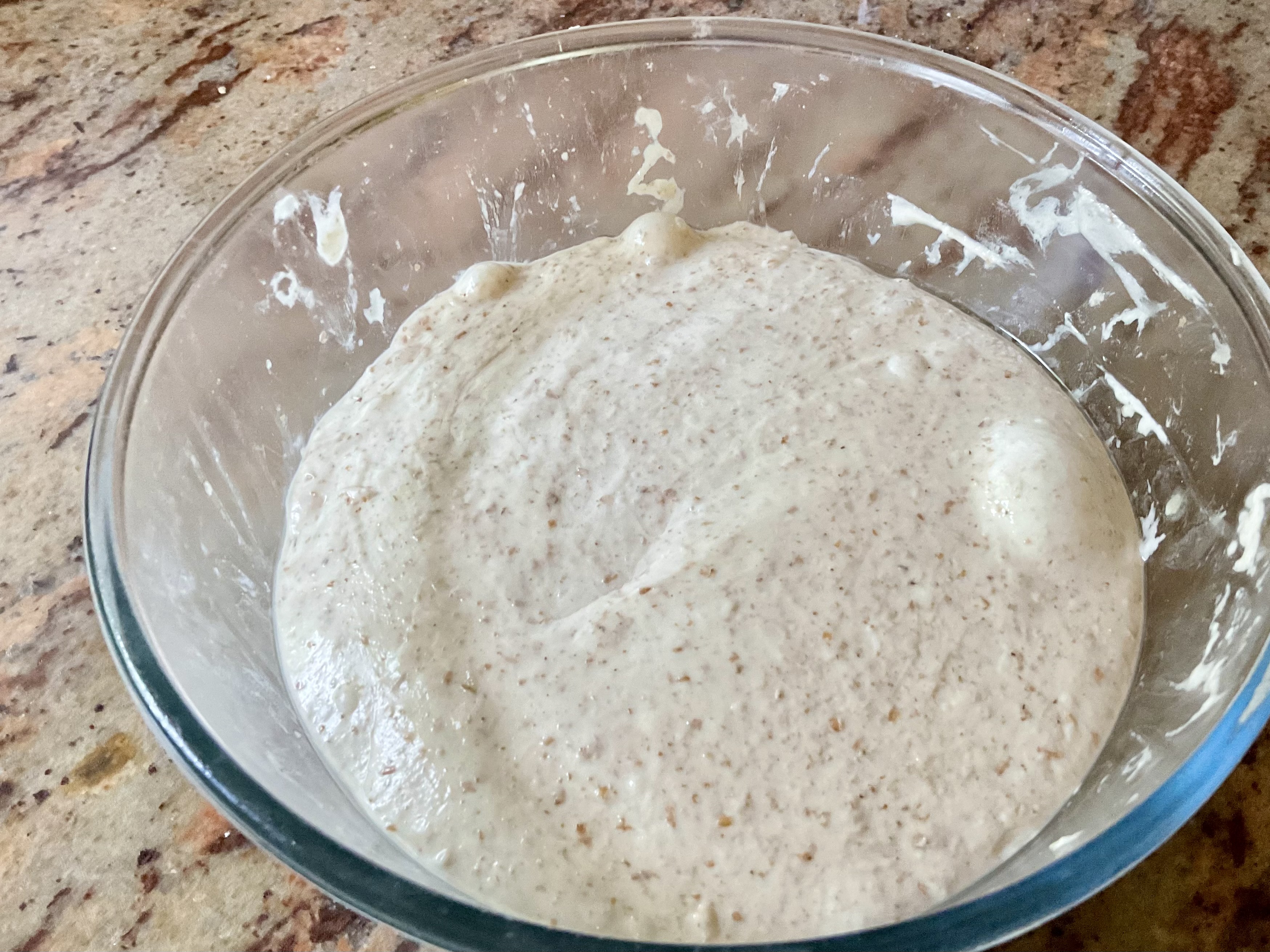
(8) Turn out onto a floured surface, cut into four equal portions and shape: see “Shaping” above recipe. Or simply shape to a rough cylinder as best as you can.
(9) Lift the shaped dough onto the baguette trays. Leave uncovered at room temperature for an hour: they will not double in size but will merely expand a little. However, you will get good oven spring when they bake.


(10) During this proving, preheat oven to its highest setting and place a solid baking tray on the bottom of the oven. Once proved, dust the tops lightly with flour and score the shaped dough with a sharp knife or blade. If the blade is not cutting easily and the dough seems to be tearing, just bake them as they are.


(11) Pour cold water or throw a handful of ice cubes into the baking tray to create steam and bake for about 10 minutes before turning down the oven to 220°C (fan) and baking for a further 15 -20 minutes until they turn a deep golden brown colour.


 Phil's Home Kitchen
Looks amazing. I can feel the crunchy crust even from the photos! 🙂
LikeLike
The crust is great. And it was such a surprise to have the most minute amount of yeast yet delivering results that are better than those made with typical amounts of yeast. I love investigating different approaches and when they work it is even more exciting.
LikeLike
wow these are fantastic baguettes. I made up a batch, baked them last night and they are top quality baguettes. I am now going to try this approach with a loaf
LikeLike
It does work wonderfully for loaves, especially free-formed ones such as boules etc…
LikeLike