
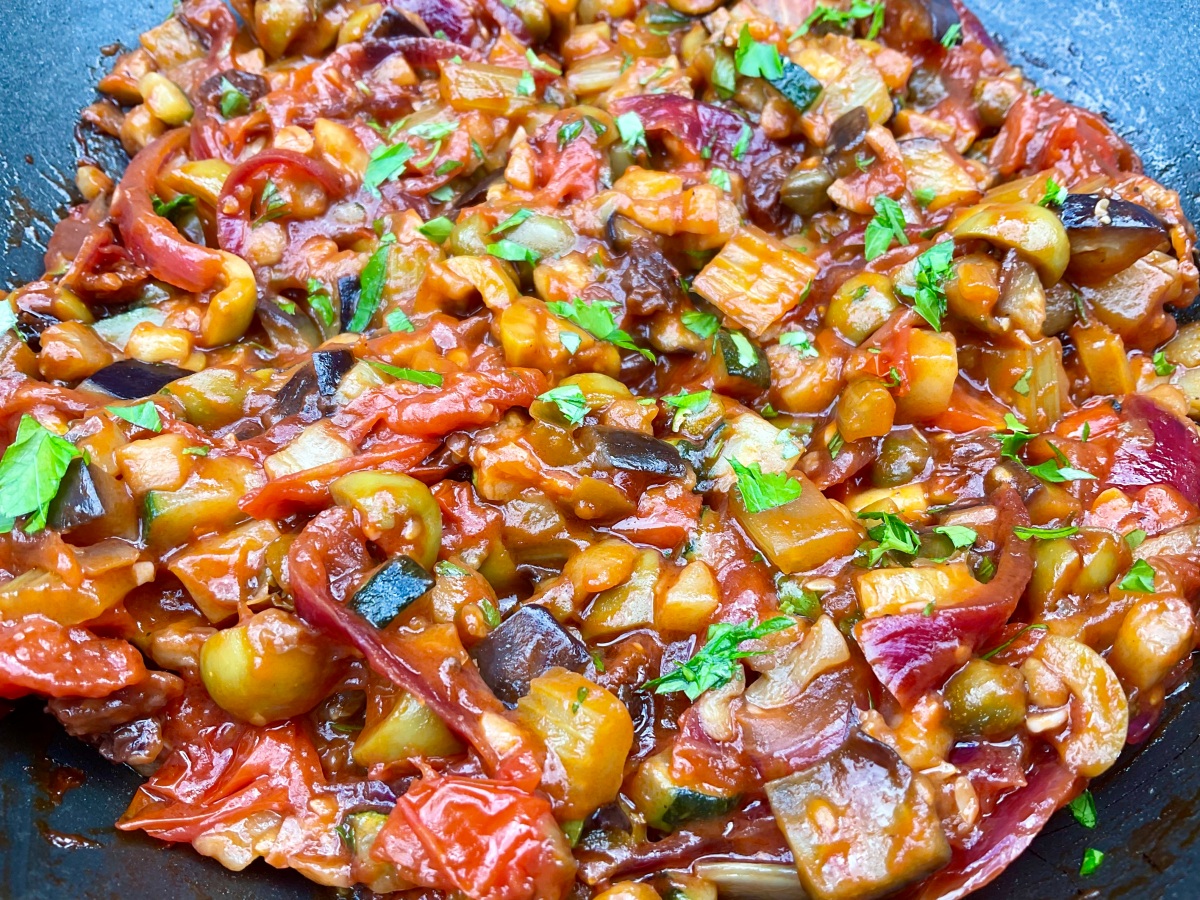
This is a seriously wonderful Mediterranean dish of vegetables coated in a tangy tomato sauce.
Caponata makes great use of delicious ingredients such as aubergines, celery, red onions, courgettes, tomatoes, olives and capers. You can also use unripened tomatoes in the recipe. The tangy sauce that just coats the vegetables – a mixture of sour, sharp and sweet – is wonderful.
Caponata is wonderful spooned over toasted ciabatta or baguettes, bruschetta-style, which is my absolute favourite way of eating it. Caponata has also proven itself to be a hit at BBQs, with the it spooned into burgers buns in place of ketchup or relish.
Other ways to use it include:
- tossed through cooked pasta (it’s also great as a bolognese alternative or used as the key sauce in lasagne)
- as a bed for roasted fish or meat to sit on: oven- roasted chicken is particularly excellent
- as a chunky dip, needing just good bread to dive right in and scoop it up!
It is worth pointing out that caponata comes even more alive if served at room temperature a day or so after making, by which time the flavours will have developed even further. But it can be used as soon as it is made.
About the recipe
I had never eaten caponata until a recent cruise I took, where it was served to me at the start of a meal.
At first I thought it was very much in the ratatouille camp – a dish I find hard to get excited about! – but I was so wrong!

Despite the similarities, caponata is certainly not ratatouille. I found the caponata to have much more flavour, with its enticing combination of sweet, sharp and sour notes. The vegetables in caponata retain their texture and identity, so it is less mushy than a ratatouille can be.
There are so many different versions of caponata. This is my version of the one I tasted, using pointers from the chef on the cruise as a starting point (he emphasised the importance of the vinegar and the capers) and a couple of attempts at home to nail it.
Is my caponata truly authentic? Probably not.
Does it taste great? Absolutely yes!
If you don’t want to fry the vegetables, you can roasted them in the oven: 180°C for 20-30 mins for each burst of frying in the recipe works well.
Recipe: caponata – serves 6 as a starter

- 1 medium aubergine, cut into small cubes
- 1 medium courgette, cut into small cubes
- 3 large cloves of garlic, peeled and crushed
- 1 celery stick, trimmed and cut into small cubes
- 1 red onion, peeled and either sliced or diced
- 1 red pepper, deseeded and cut into small cubes
- 4 large tomatoes, cut into small pieces – no need to peel!
- 200g passata (I use about half a carton and freeze the rest)
- 60g green olives, quartered or halved
- 50g capers, drained
- 50g raisins
- 20g caster or granulated sugar
- 100ml red wine vinegar
- about 1 tablespoon parsley (stalks and leaves), finely chopped
- 60ml olive oil
- 1 teaspoon sea salt
- several grindings of black pepper
To finish:
- 1 tablepoon finely chopped parsley
- 1 tablespoon balsamic vinegar
(1) Heat about half of the oil in a large pan or wok over a medium heat and add the cubed aubergines and courgette along with about half a teaspoon of salt. Fry gently for about 15 minutes, stirring very gently after 5 minutes or so, until they have softened and have golden-brown tinges.
NB: don’t stir too much – the trick is to let the heat of the pan slowly colour the aubergines and courgettes a little before giving them a gentle stir to turn some of them over before continuing the colouring.
(2) Spoon the aubergines and courgettes into a bowl and stir in about half of the crushed garlic. Set aside.

(3) Add the rest of the oil to the pan or wok and heat gently. Add the celery, the red onion, red pepper and the rest of the garlic.
(4) Fry gently for about 10 minutes or until the onion is soft and takes on a little golden-brown colour.
(5) Stir in the rest of the ingredients, including seasoning, and bring to a simmer. Continue to simmer gently with the lid off for about 20 minutes or until the tomato sauce has well reduced by a least half and is merely coating the vegetables.
NB: as the sauce reduces, the flavour intensifies.

(6) Remove from the heat and stir in the cooked aubergines and courgettes, coating them well in the sauce.

(7) You can serve the caponata immediately – eg) if using as a pasta sauce – but if you can wait, allow it to cool before covering it and popping in the fridge. You can refrigerate the caponata for 2-3 days until you want to use it to ensure the flavours develop even further.
(8) When you want to eat the caponata, take it out of the fridge and decant into a serving bowl. Once it has reached room temperature, drizzle over the balsamic vinegar and scatter over the parsley. Dive in with chunks of good bread!


 Phil's Home Kitchen
Looks like summer!
LikeLike
Yes indeed. And made with freshly picked produce in the coming months it will be even better
LikeLiked by 1 person
My taste buds are skipping at the thought of this lovely dish. Bring on the crusty bread!!
Mary :))
LikeLike
this certainly looks delicious Phil. I agree with you about ratatouille – generally mushy and tasteless but this sounds great!
cheers
sherry https://sherryspickings.blogspot.com/
LikeLike
It’s such a good dish and a far cry from ratatouille.
LikeLike