

A decent sourdough loaf is joy to eat: a crispy crust, a soft but slightly chewy interior and layers of flavour in each bite.


- About the recipe
- The recipe for a standard sourdough
- Slight variations to this recipe
- A sourdough making schedule that works for me
- Using a dough proofer
- Making a sourdough starter
- Maintaining the starter
- Levains
- A weakened starter
- The “stretch and fold” method
- The crucial bulk fermentation stage and what to look for
- Preshaping
- Bannetons
- Shaping
- Cold retardation: a natural flavour enhancer!
- Scoring/slashing the dough
- To steam or not to steam
- Craving a more tangy bread?
- Different flavours for sourdough
- Other recipes using sourdough starter
NOTE: If you are new to sourdoughs, I really recommend reading all of the sections first. My full guidance for making and maintaining a starter, the benefits of a levain versus a starter, handling the dough, fermentation and shaping are below the recipe, along with ideas for flavour variations.

About the recipe
I love sourdough bread and have been making sourdough bread for almost 40 years. That said, a bread made with commercial yeast is still a joy and is something I also make often.

Now I am certainly no expert, but the recipe below gives what I think is a delicious sourdough and, crucially, reliably!

I got the gist of this recipe and the starter – the mother starter – when watching a daytime TV programme decades ago: back then, making yeasted bread at home – let alone sourdoughs – was by no means “a thing”.
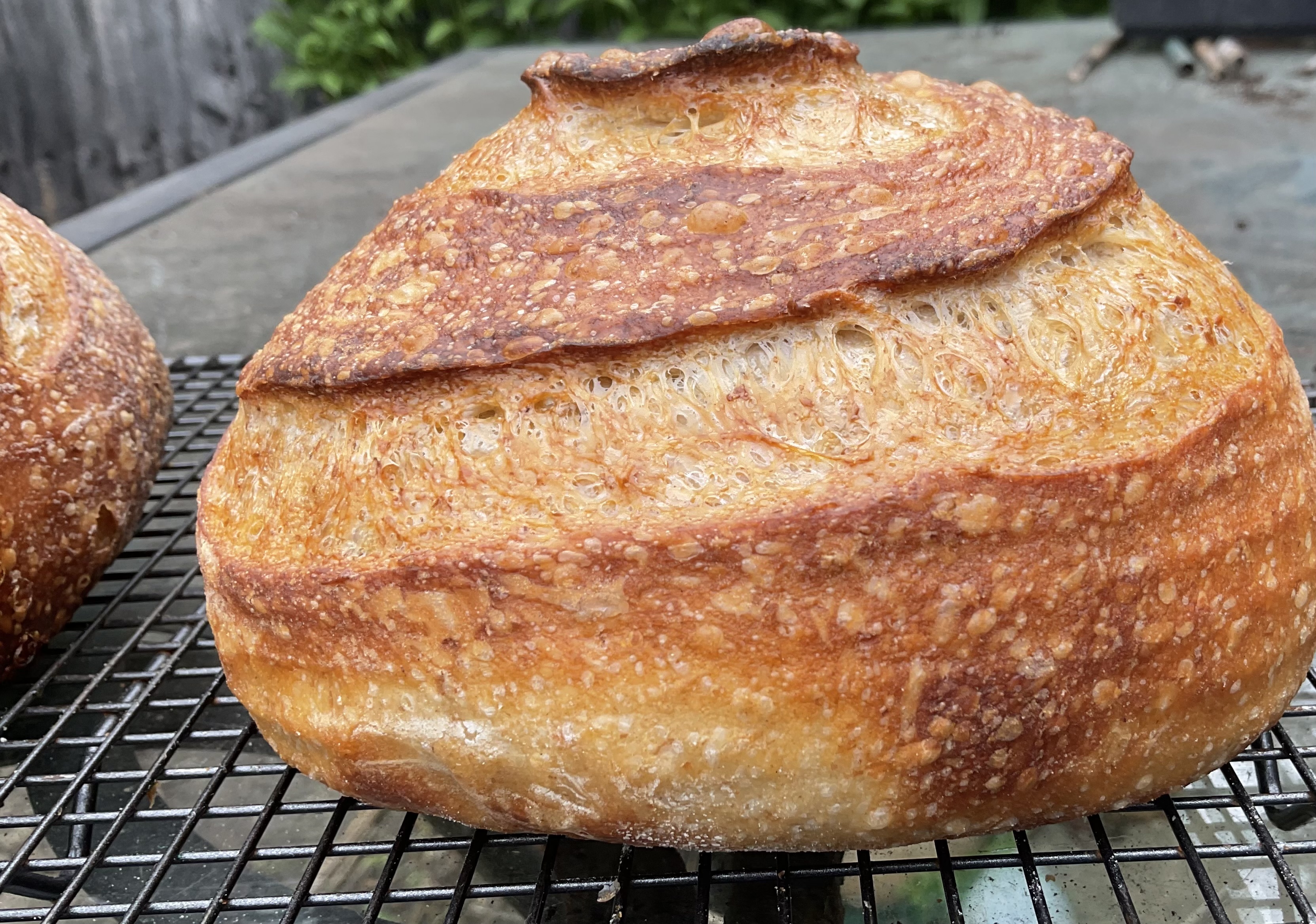
Over the years I’ve adapted the recipe that I’d scribbled down in my quest for even better loaves that work reliably for me.
Of course, there are now so many different recipes and methods for sourdoughs that it can be very daunting to know where to begin or which to choose.
Making sourdough can be a challenge and I have certainly had spectacular disasters: but it takes practice to get a real feel for the process.
But if you take it gently, focusing initially on a basic sourdough (as in the recipe below, which does not have a very high water content so the dough is easier to work with), you will become more comfortable with the process.
The recipe for a basic sourdough (makes 1 large loaf or 2 smaller loaves)
Update: I have added temperatures if using a dough proofer, which I now often use for my breads, but a proofer is not essential.
For the thick levain (which gives 100g):
- 20g active starter, ideally fed the day before but this is not essential
- 50g very strong plain white flour (or use wholemeal, spelt, rye or a mixture)
- 30g water
For the dough:
- 500g very strong white plain flour (around 13 to 14% protein)
- 100g thick levain: it should be very bubbly (above)
- 340ml water
- 10g fine sea salt
Note: you can use a standard bread flour/strong white flour (around 11 to 12% protein), but I now prefer the more robust dough structure and final texture of the baked sourdough when using a “very strong” flour.
To finish:
- fine semolina or rice flour for the bannetons/baskets
- a few ice cubes
- a spray bottle filled with water
You will also need either one large banneton or two smaller bannetons, dusted generously with a mixture of fine semolina and/or rice flour
(1) Several hours before you want to make the dough, make the levain by mixing the 20g starter with the 50g flour and 30g water: this will be a very stiff levain: more like a dough than a rather than runny batter. Cover loosely and leave until it has at least doubled in volume and is aerated. You can use a marker pen to mark the initial depth to see progress (as in the photo below), or judge it on very visible bubbles inside.
[Dough proofer temperature: 25°C]

NB 1: I now find a very thick levain such as this gives the most reliable results
NB 2: You can also use a different flour such as white, wholemeal, buckwheat etc in the levain
NB 3: There is no time urgency here and it really doesn’t matter if you’ve left the levain too long and it has collapsed a bit. I’ve left a levain until it has significantly collapsed but once added to the flour, water and salt it has bounced back perfectly.
(2) Add the flour, salt, water and this well aerated levain to a bowl. Mix together with a wooden spoon or a flat-bladed knife to give a fairly rough, shaggy dough with no visible bits of flour.


(3) Cover the bowl with a shower cap or cloth and leave on the worktop for between about 30 minutes or so, which will help the flour hydrate.
[Dough proofer temperature: 25°C]
(4) Do a stretch and fold session for a couple of minutes or until the dough comes together and can easily be lifted out of the bowl in one piece (see The “stretch and fold” method below). Cover again and leave for about 30 minutes.
[Dough proofer temperature: 25°C]
NB: you don’t need to stick rigidly to 30 minutes: I vary from between 30 minutes and around an hour. A bit longer is not a problem either! This is part of what is known as the bulk fermentation stage, during which the natural yeasts are given the chance to slowly multiply.

(5) Repeat this stage until you have done 3 to 4 more “stretch and fold” sessions, covered the dough and leaving it for around 30-60 minutes between each session. [Dough proofer temperature: 25°C]
NB: with each stretch and fold session, the gluten develops and the dough builds strength so that it lifts out of the bowl in one go more easily and with minimal effort. You should also feel the dough has become smoother and eventually more aerated.
(6) Cover the bowl of dough again and leave on the work top for the rest of the bulk fermentation stage until the dough has risen by about 50-75% of its initial volume, is slightly domed, is jiggly when you gently shake the bowl and has a few bubbles on the surface. It might be easier to see its volume increase if you decant the dough into a plastic container – as in the photos below – but see the section on The crucial bulk fermentation stage and what to look for below this recipe for other signs to check when it is ready. [Dough proofer temperature: 25°C]
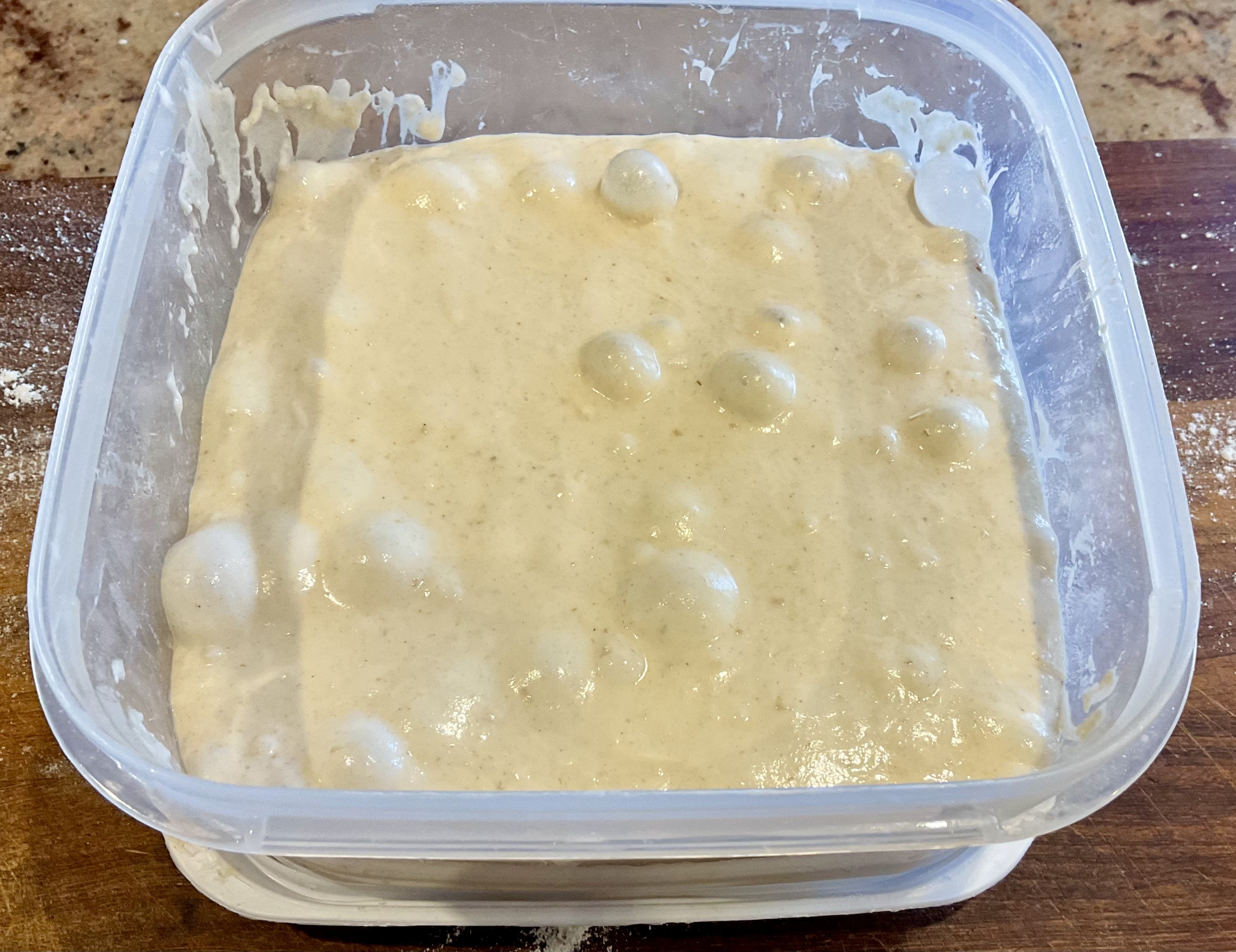
NB 1: precise timings do not work with bread, especially sourdough, so it is essential to keep an eye on the dough. I strongly advise against going for a doubling in volume as this usually gives a dough that is over-proofed and is more prone to collapsing later. I find a 50-75% or so increase works best.
NB 2: other visual signs include a slight dome on the surface and a few bubbles visible on top. You can also see many air holes up the sides of the container.
NB 3: Be especially careful if the dough is proofing in a warm room as it will rise more quickly; if you over-do this you might end up with a very loose, almost runny dough which will not shape well or hold its structure.
(7) Turn the aerated dough onto a lightly floured surface.
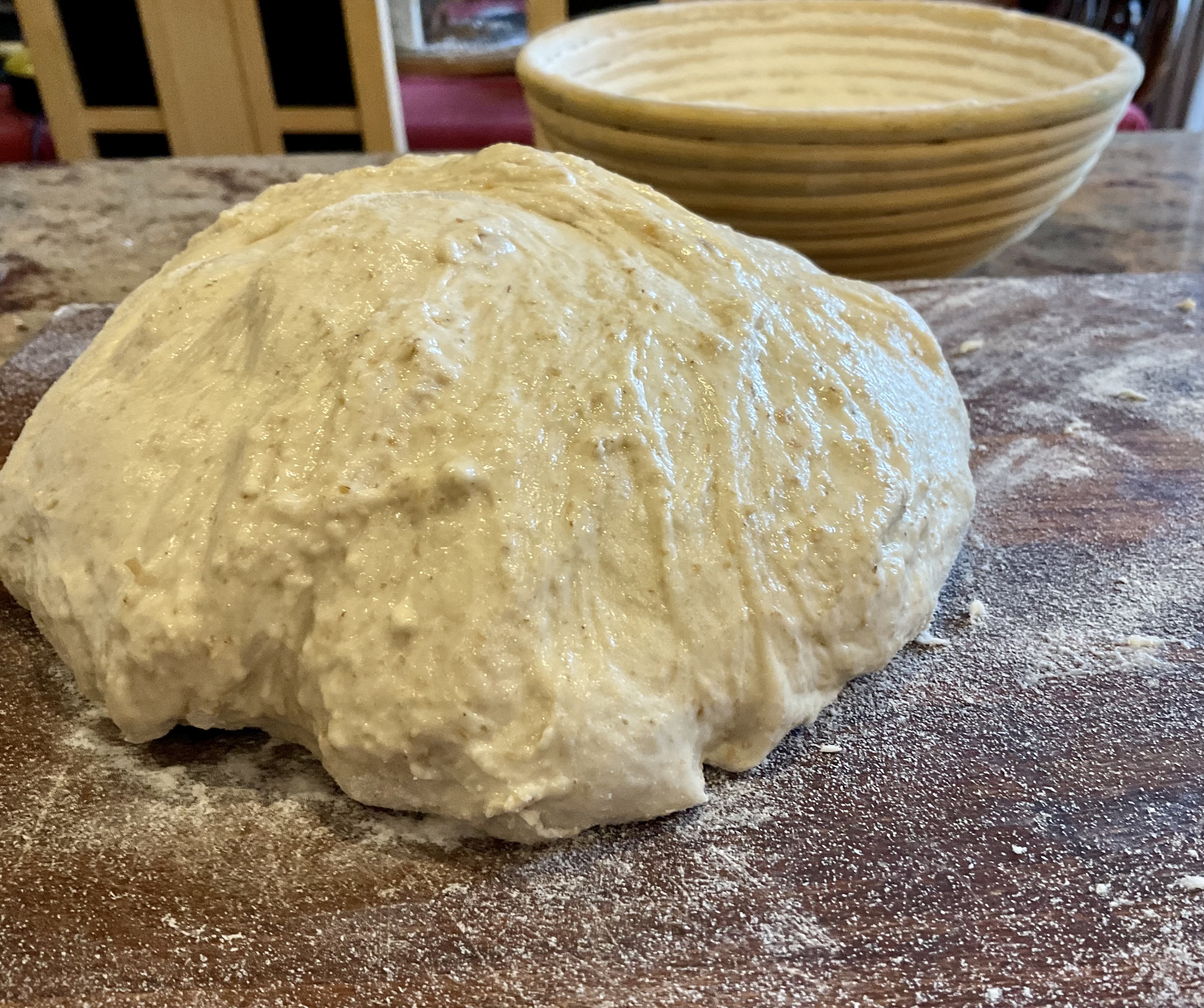
(8) Shape the dough – see below recipe for how to shape – and dip into fine semolina or rice flour to give a light coating all over the dough.
NB: you can pre-shape the dough first if you wish – this is not essential for a dough such as this which does not have a high water content, but I sometimes do this out of habit. See notes on pre-shaping below the recipe.

(9) Place in a banneton that has also been liberally sprinkled with fine semolina or rice flour, seam-side upwards and dust a little more semolina/rice flour over the top. You can gently pinch the seam into the dough if you wish, but this is not essential.

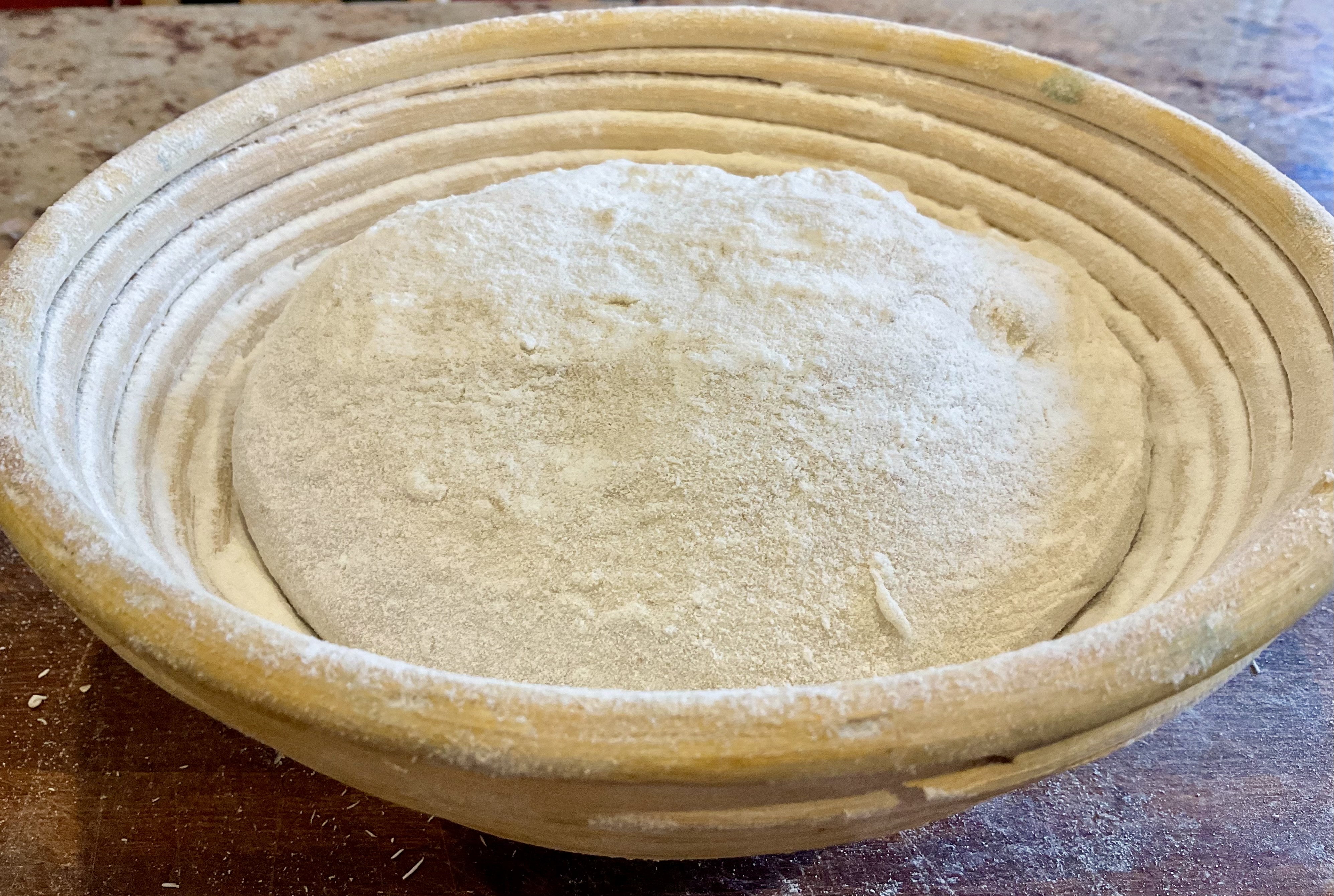
(10) Cover again and leave at room temperature to increase in volume just a little. For me, this is typically a rise of 2-3 ridges up the banneton or just coming to the top. [Dough proofer: temperature 25°C]
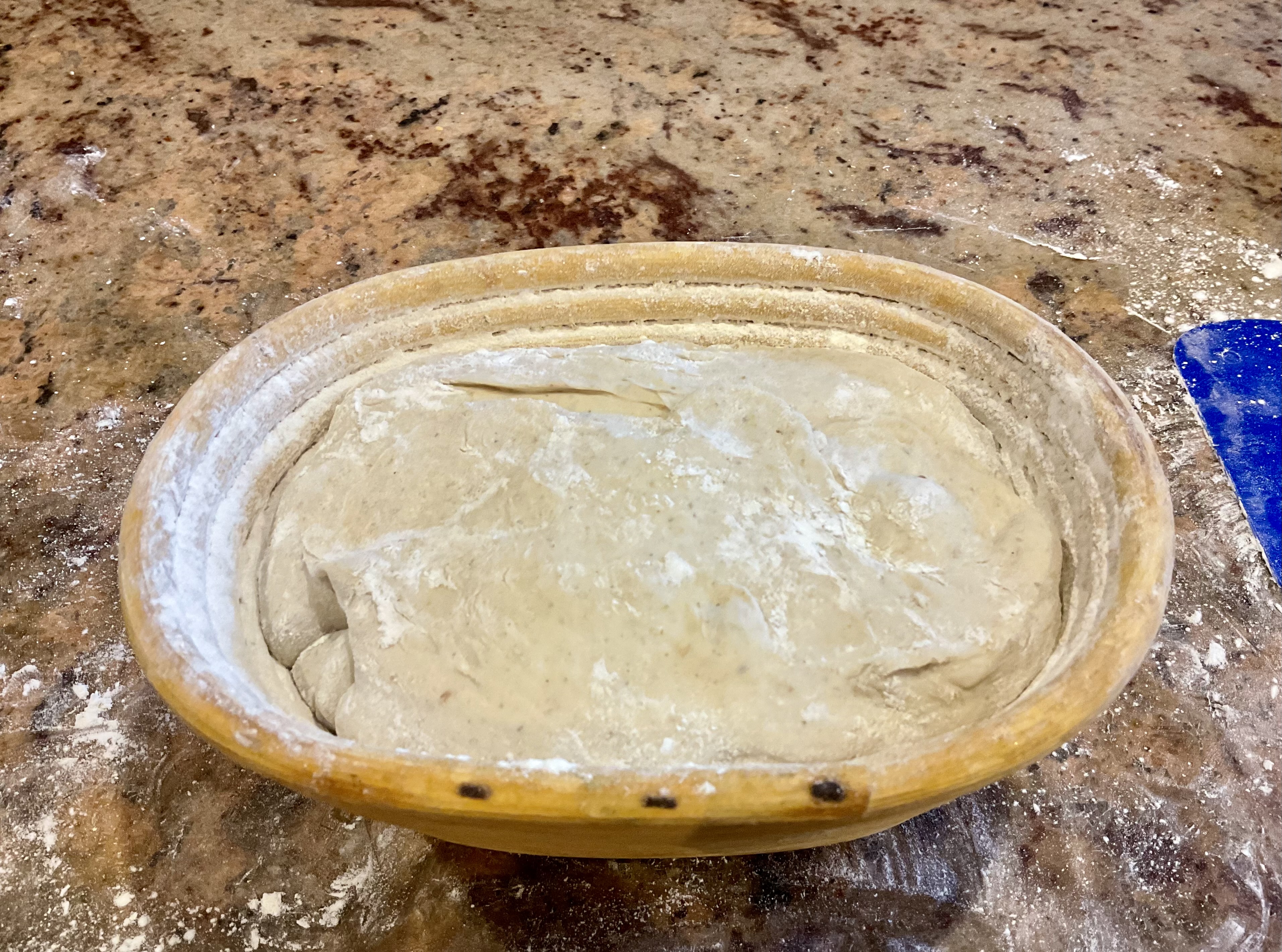
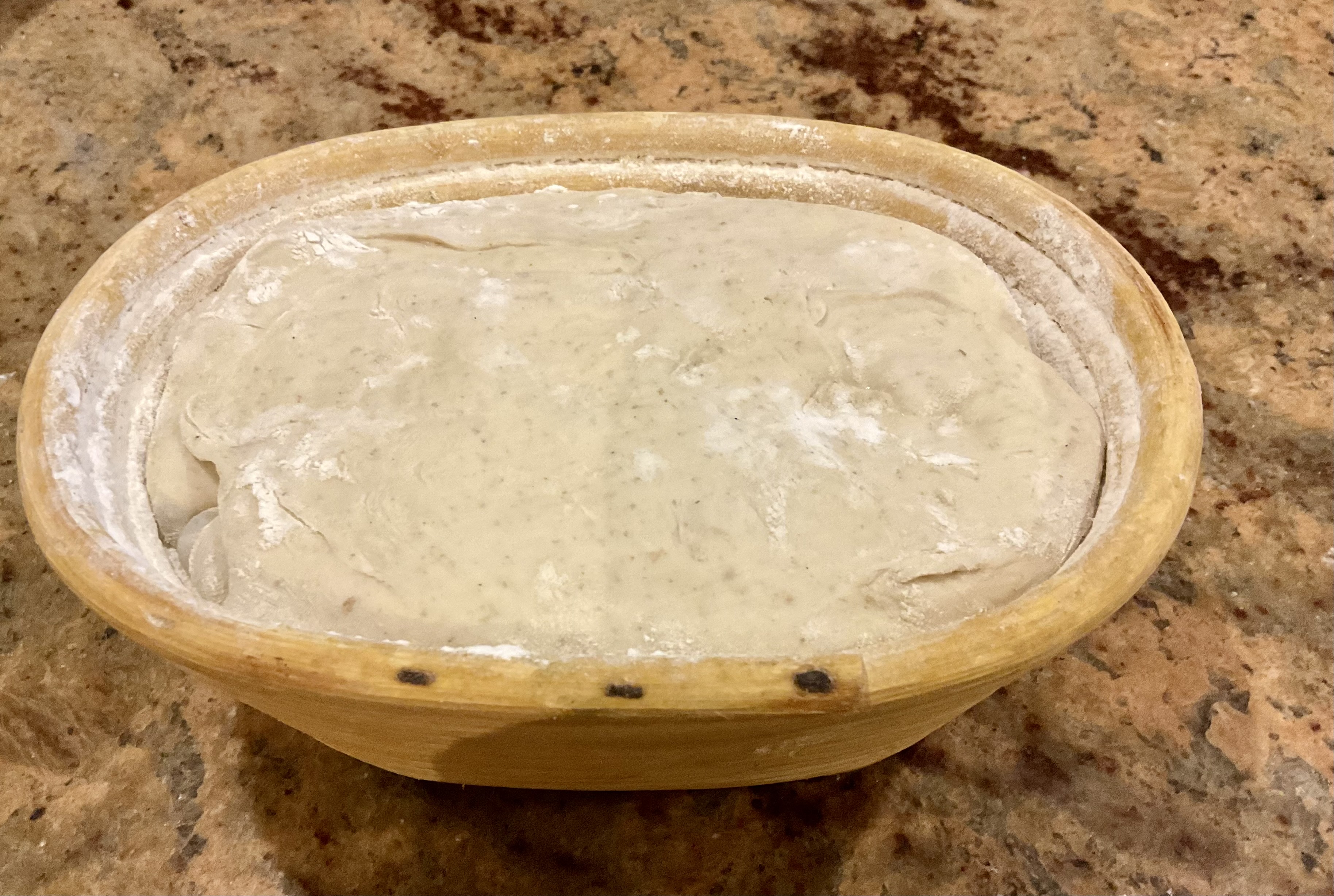
NB 1: this stage is mainly to allow for the dough to expand again after handling it previously for its shaping so it regains a bit of its volume. I find this typically takes around 3-4 hours in the dough proofer at 25°C or in a warm kitchen.
NB 2: whilst I visually look for a rise of just 2-3 more “ridges” up the bannetons, you can do what is known as a “poke test”:
- sprinkle a little flour over part of the dough
- gently press a finger about a centimetre into that part of the dough and then remove your finger back out of the dough
- if the indent fills in slowly but there is still a bit of an indent, it is proofed enough
- if the indent fills back in almost immediately, the dough is under–proofed and the dough needs a bit more time to proof
- if the indent barely fills back in, the dough is over–proofed. In which case I would bake it as soon as possible
(11) Put the banneton, still covered, into the fridge for its cold retardation for around 6 hours, but ideally at least overnight for more flavour. I often go for around 24 hours, but if you like a tangier loaf you can take it to about 36 hours.
NB: this chilling is when a lot of the flavour will develop. The fridge significantly slows down the fermentation so there is no danger of over-proofing at this stage. The cold dough will also be much easier to score and will give you good oven-spring (the jump in volume of the dough in the heat of the oven).
(12) About an hour before you are ready to bake the sourdough, turn the oven to its highest setting and place the base of a Dutch oven or similar pot into the oven to heat up for about 30-45 minutes so it can get really hot. The ones I typically use are in the photo below: from left to right they are a cast iron Dutch oven, a cheap and battered metal casserole pan and a ceramic spring oven. Each works very well indeed, with little difference overall.
NB: alternatively, heat up a solid metal tray or baking stone in the oven and place a solid metal roasting tray underneath

(13) Carefully put the hot Dutch oven onto the hob. Put a sheet of greaseproof onto the top of the banneton and use oven gloves to place the bottom of the hot Dutch oven over this (so the banneton is inside the Dutch oven). Invert slowly and carefully to allow the dough to release itself from the banneton, where is will now be sitting on the greaseproof on the base of the Dutch oven.
NB: if using a solid baking tray/stone, place greaseproof on a chopping board or baking peel and invert the dough gently onto this.
(14) Cut the surface of the turned-out dough with a sharp blade, going about a centimetre deep and at roughly a 45° angle. You can do this across the top or along the side: see Scoring the dough below.

(15) Pop 2-3 ice cubes onto the base of the Dutch oven, spray the dough generously with water a few times and put the lid on so the dough is fully enclosed and can trap the steam that will be released.
NB 1: the ice cubes and spraying really help get a lovely blistered crust. Crucially, though, the steam moistens the surface of the dough just long enough to prevent it firming up too much so that it can go for a really good expansion/open spring.
NB 2: if using a solid baking tray/stone, either scatter a handful of ice cubes onto the roasting tray at the bottom of the oven or pour in a mug or so of boiling water. Don’t put the ice or pour water onto the baking stone as it is likely to shatter!). Spray the scored dough liberally with water and slice it into the oven and onto the very hot baking stone the greaseproof on the peel or chopping board will help it slide on there with ease. See photo above of a loaf on the peel, ready to slide onto the baking stone in the oven.
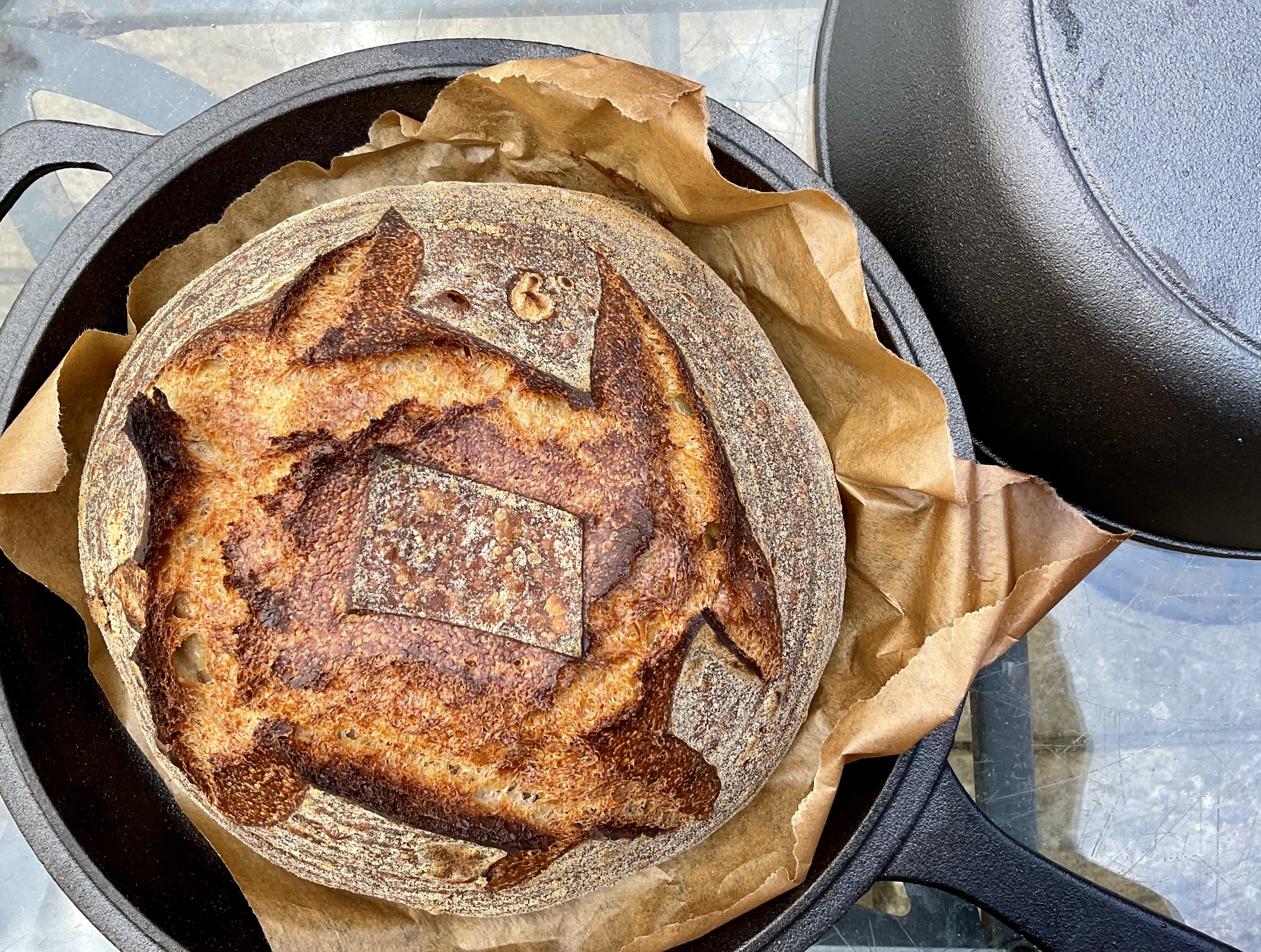
(16) Bake for 25 minutes and then remove the lid of the Dutch oven and turn the oven down to about 200-210°C . Continue to cook for a further 15-20 minutes: you want a darker golden colour, or even take it further, which will have the most amazing crust with a fabulous flavour.
NB: if using a baking tray/stone, bake for about 50 minutes in total, reducing the temperature to 200-210°C after about 20 minutes.

(17) Transfer to a wire rack to cool fully before slicing.
Slight variations to this recipe
Variations that I go for from time to time – depending on my mood! – include:
- adding other flours such as wholemeal, einkorn or spelt when making up a dough: for 500g flour for a dough I tend to go to for no more than about 100g of other flours ie) 400g very strong white flour and 100g other flours. This works well as a mixture of additional flours, and sometimes I will use what I have lying around. One of my favourites is to have 400g very strong white flour, 50g spelt and 50g wholemeal.
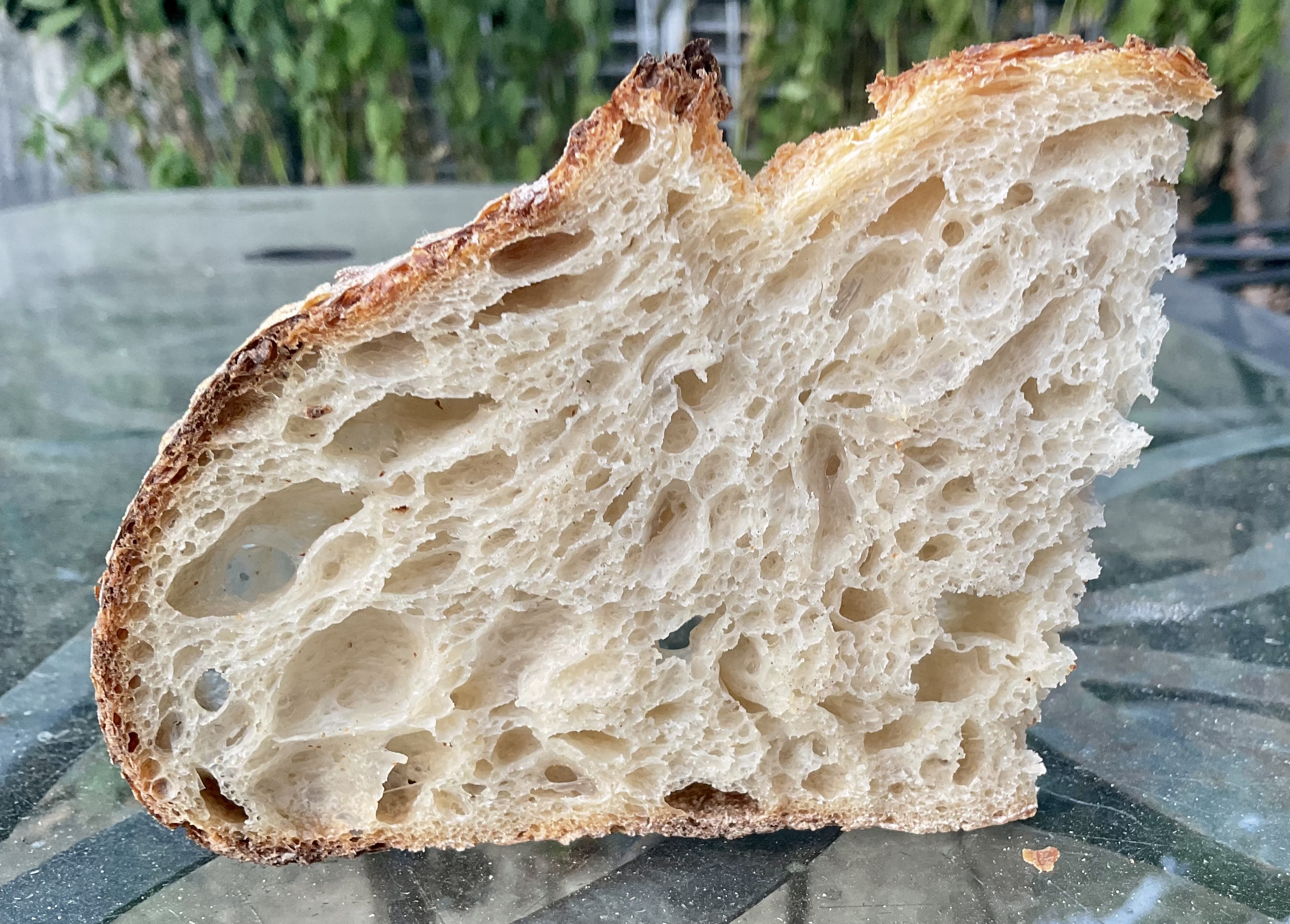
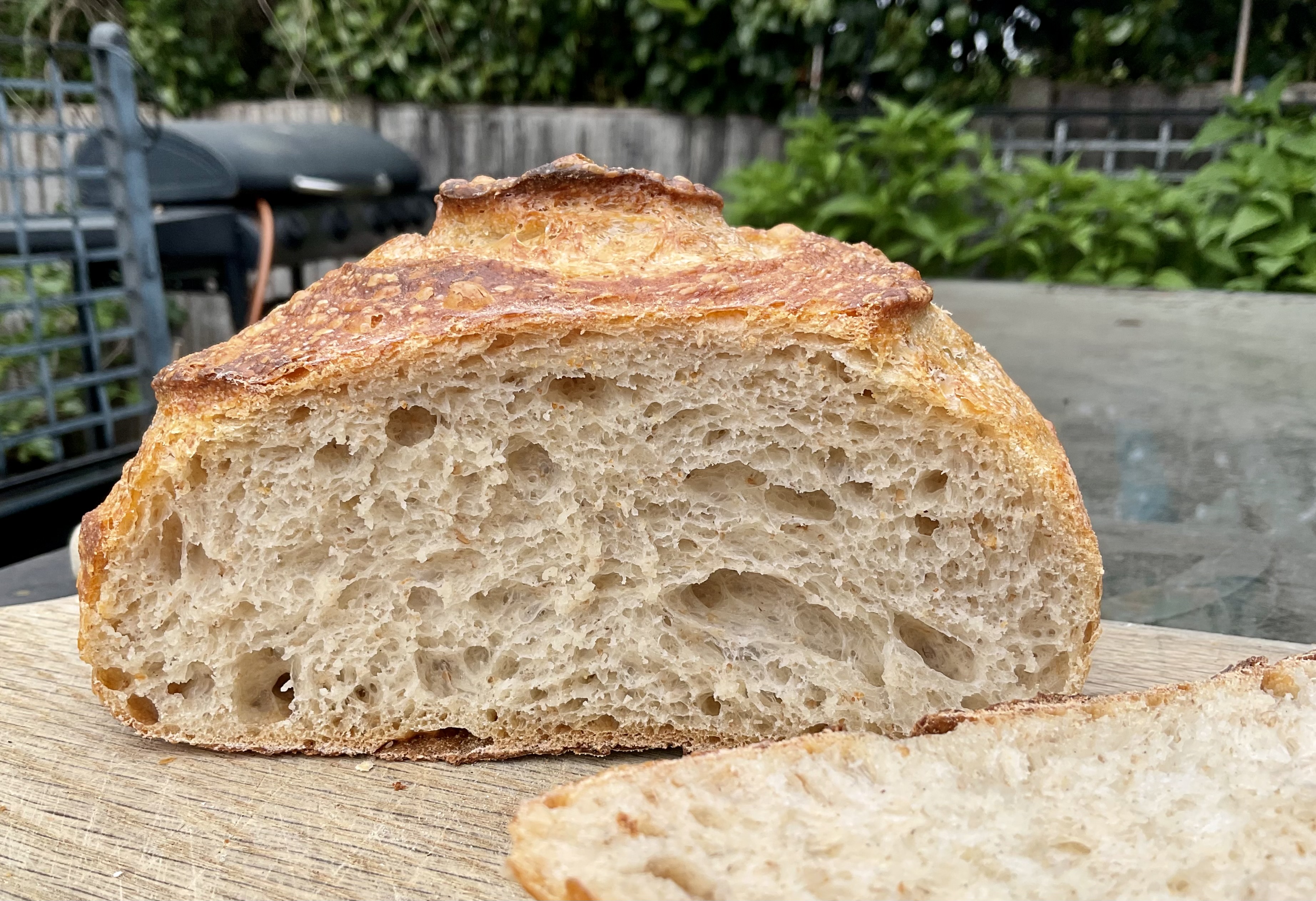
- adding 20ml to 30ml more water in the dough recipe. This will give a more open internal crumb structure (see photo below). A higher water content gives a slacker dough initially but with the stretches and folds it will be able to support its shape when it is turned out of the banneton (as long as it is not over-proofed)

A sourdough making schedule that works for me:
Sourdough cannot be rushed. It takes the best part of 3 days for a really good loaf, but most of this is simply letting the dough do its thing: and it is well worth waiting for!
The key stages for making sourdough are:
- feeding the starter and making up a levain
- making up the dough initially
- bulk fermentation, including the stretches and folds
- shaping the dough
- letting the dough prove
- refrigerating the dough (cold retard)
- baking
I tend to go for the following schedule when making sourdough:
– Day 1 evening: mix up the levain ingredients so that it is very active and aerated by the morning
– Day 2 morning : make up the dough, do the stretch & folds and leave overnight to finish its bulk fermentation
– Day 2 from mid afternoon: shape the dough and let it proof for a few hours
– Day 2 evening: put the dough in the fridge
– Day 3 morning or afternoon: bake the dough

Using a dough proofer
As my kitchen is usually on the cold side, I now use a dough proofer. This allows me to keep my dough at a consistent temperature and has been a game changer for sourdough making.
For me the dough proofer has really made things more controllable and reliable when it comes to sourdoughs.

I have experimented with different temperatures in my proofer and I now settle on the following for the each stage. However, the timings are merely a guide: see my notes with each stage of the recipe in terms of what you are looking for with the dough:
- after feeding starter/making a levain: 24-25°C until around doubled to tripled in size.
- resting dough around the stretch & folds: 25°C
- main bulk fermentation: 25°C for roughly 8-9 hours or overnight
- shaped dough: initially for 25°C for roughly 3-4 hours
- chilling the shaped dough: in the fridge for up to about 36 hours.
Making a sourdough starter
The starter is the heart of the sourdough loaf and contains natural/wild yeast and micro-organisms that allow the bread to rise. Acids are also created: if you get more acetic acid (from wholegrain flour in the dough and not feeding the starter as often), you can get a tangier loaf. See “Achieving a more sour or less sour bread” below.
You can buy sourdough starter, but it is easy to make: just don’t be put off by around a week of waiting until it is ready to use properly. Once made, it will keep almost indefinitely if well looked after.
The starter I use at home is many years old and keeps well in the fridge. I feed it just once a week or so with a little bit of flour and water to keep it going, but it can go for a couple of weeks without feeding.
Making a starter from scratch:
Day 1: mix together about 30g each of strong plain white flour and water to make a thickish batter. Cover with a clean cloth and put it in a warm place such as the airing cupboard for two days.
Day 3: the mixture should have some small, thick bubbles appearing. Mix in another 30g flour and 30g water, cover and leave it for a day.
Day 4: feed it with another 30g of both flour and water, cover and leave it for another day.
Day 5: there should be more bubbles in and on the starter. Remove about half of this mixture* and then feed it with another 30g of both flour and water and leave it for another day.
*you can give this “discard” to someone who wants a starter or you can already use it in other recipes: there are a few ideas at the bottom of this page
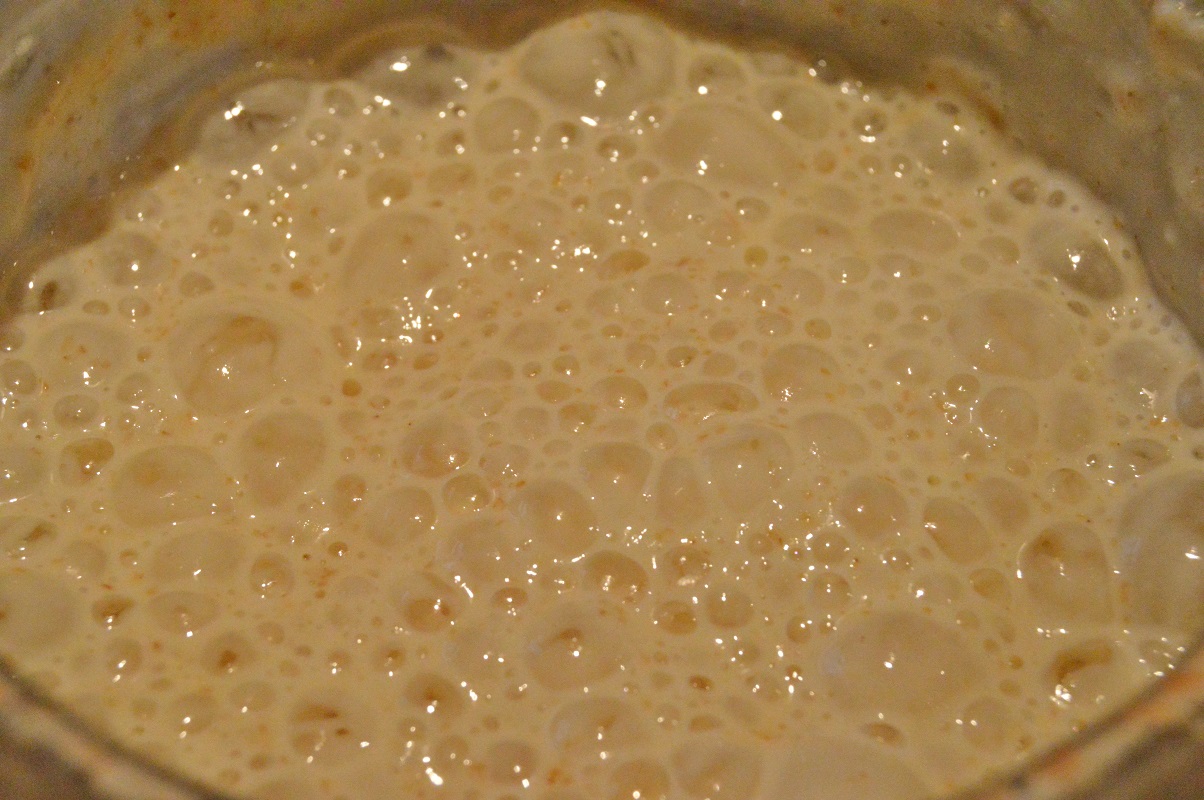
Day 6: the starter should now be very bubbly (how a white-ish chocolate aero bar might look like!) and have a slight vinegary aroma to it. Leave it be at this stage.
Day 7: feed with another 30g each of flour and water and leave a day or so before using. This is now your mother starter. It will be quite weak so if you use it at this point for a bread it might not have the structure you would like. However, as you feed your starter more, it will build up strength to make great loaves.
Maintaining the starter
I cover my starter with a clean cloth and leave in the fridge most of the time. However, make sure you don’t put on a tight-fitting lid as the build up of gases could make the starter jar explode – as I discovered very early into my sourdough journey!
If you leave the starter too long without feeding you will find a clear liquid, which might be very pale or slightly yellowish – floating on top. While it might look unsettling, it will be absolutely fine if it smells vinegary and is not too dark: you simply stir it back in.

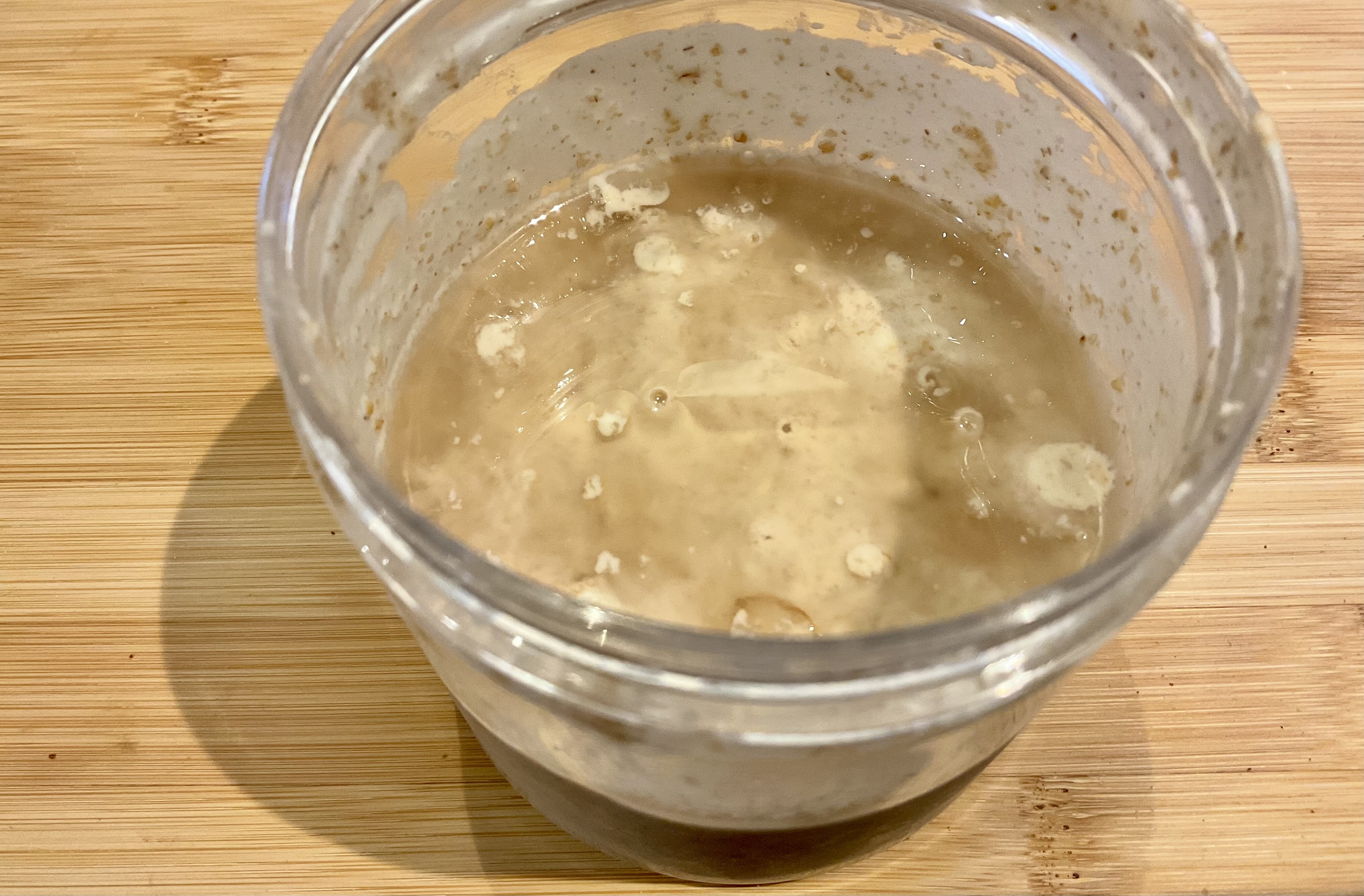
However, if it develops a very dark or even black liquid (for example if you’ve not fed it for many weeks) and it smells rank, simply pour that liquid away and discard the top centimetre of so of the remaining starter. Give the rest of the starter a few feedings to get it going again.
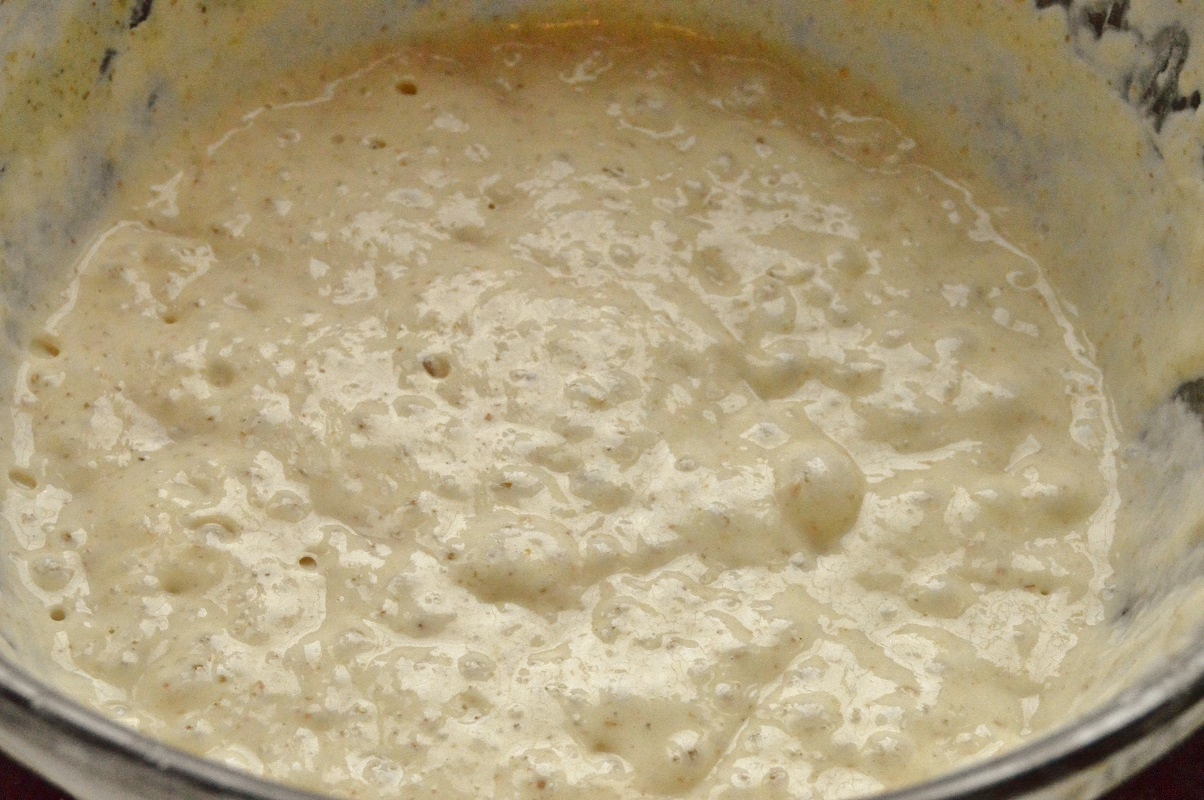
As you do not need much starter in a recipe, I now only keep about 50g of my mother starter in the fridge.
I give my starter a weekly feeding of around 20g each of flour and water: this is enough of a feed to keep her going gently. I then give her an extra feed the day before making up a dough.
When making a new sourdough loaf, I occasionally use my mother starter once fed and nicely active and bubbly. However, I now tend to use a less of my mother starter in a loaf and instead make a levain:
A levain
The levain is simply a bit of the mother starter fed with flour and water and left to ferment so it can then be used in a recipe. If I make a levain for a dough using 500g flour I typically go for a fairly stiff levain of 20g starter, 50g flour and 30g water: I find a stiff levain rather than a looser one gives a dough that is much easier to work with.
The levain or starter should be allowed to at least double in volume and become aerated before using (see photos below) but don’t worry if it is not quite there or if it has gone past this: it will still work well in your sourdough.
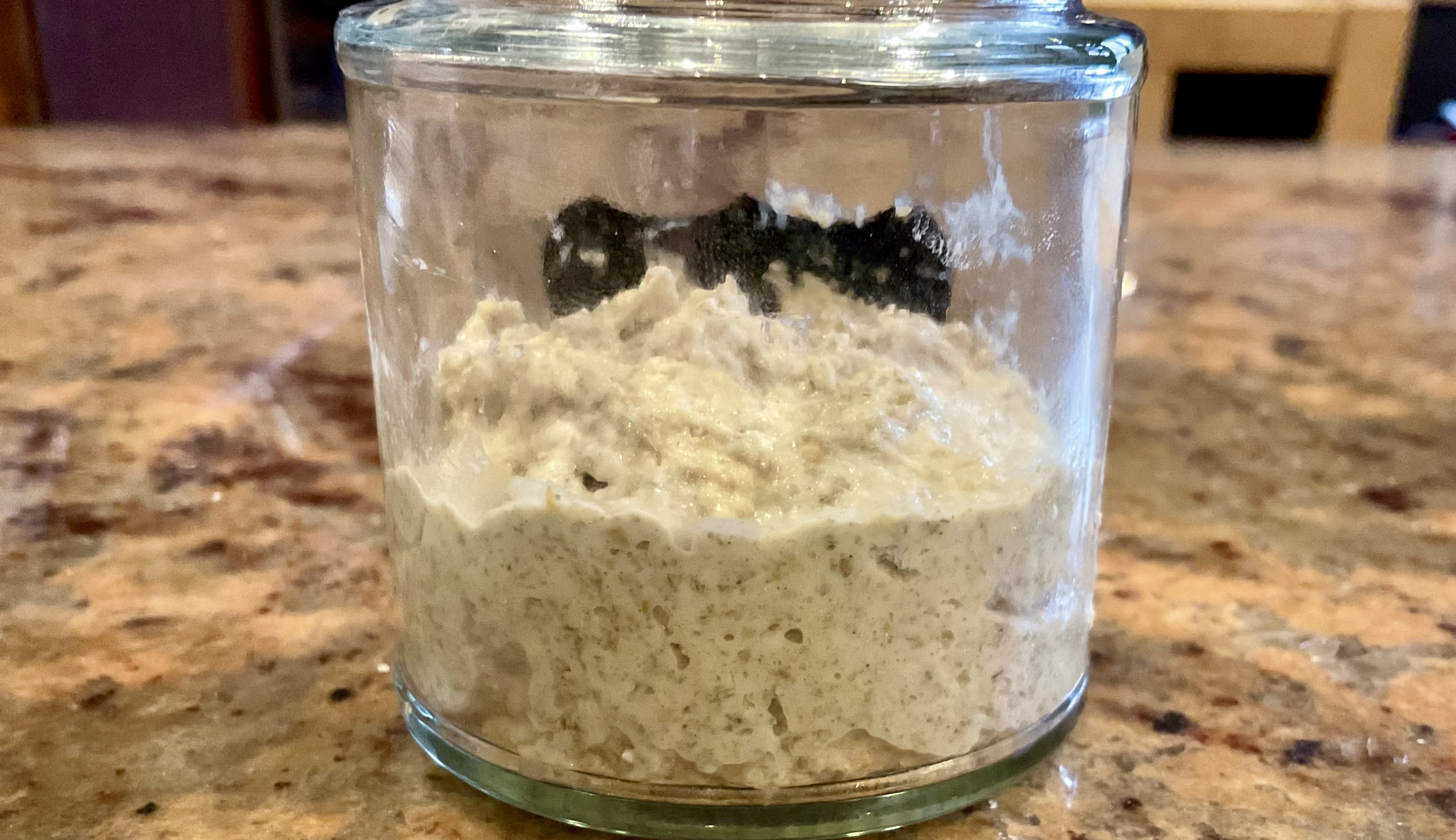

A key advantage of using a levain rather than your main or mother starter is that you are working with relatively small amounts of flour and water at a time and making up just what you need for a recipe. I find this easier to manage than having loads of jars of starter all over the place!
A levain is also less acidic than the mother starter; as gluten is weakened by acid, in the long duration for the dough to ferment, the gluten in the flour (which gives structure to the dough) does not break down so much. You therefore get a dough that is less likely to collapse into a flat, dense sourdough slab.
A weakened starter
If you find that you are not getting much rise in the starter/levain, or if you have suddenly had a batch of loaves that, despite care at every stage to avoid over-proofing, still come out flat, it is possible your starter has become too weak. This has happened to me on a few occasions over the years.
If this is the case, discard all but about a tablespoon or so of the starter and mix in about 30g rye flour and 30g water. Repeat twice a day for a few days and the starter will become lively and ready to go again.
The “stretch and fold” method
When I started making sourdoughs all those decades ago I was frequently dismayed that once the dough had its final proving and was turned out for baking, it would start to spread out in front of my eyes: a very sad sight! This is mainly because the acidity of the starter breaks down some of the gluten in the flour so it loses some of the structure it had earlier.

It is especially likely to happen if you have left the dough too long to overproof and/or have placed the dough in too warm a place.
For me, the “stretch and fold” method, in place of traditional kneading, gives me a dough that is easier to handle and very reliable loaves

The stretch and fold method is by no means labour intensive: you simply pop back to it every 30 minutes or so for just a few minutes of stretching and folding at a time. I have found this is by far the most reliable approach in terms of effective gluten development and the best overall structure.
The stretch and fold steps:
- using very lightly watered hands (wet hands don’t stick to dough!), grab part of the dough with one hand and stretch it upwards to as high as it will go. Let it fall back into the bowl (or throw it back into the bowl!).
- give the bowl about a bit of a turn and repeat this process several times for a minute or so, or until the dough lifts out of the bowl easily as you stretch it. As the gluten develops, you might find it best to use your other hand to lightly keep the rest of the dough in the bowl.
- that is one stretch and fold session.

After this session, you repeat every 30 minutes or so to have given a total of 4 to 5 “stretch and fold” sessions. With subsequent sessions, you will feel the dough has gained strength as the gluten develops, it becomes smoother and it holds its shape very easily.

With later stretch and folds the dough hangs together in one piece because it has built up strength as the gluten has developed.

The crucial bulk fermentation stage and what to look for
The bulk fermentation actually starts as soon as you have made up the initial, rough dough. The natural yeasts are already starting to feed off the sugars in the flour and multiplying.
Once the dough has had its stretches & folds, it really is important to then let the dough go through the rest of the bulk fermentation stage properly: this is one of the trickiest stages of sourdough making as you don’t want to either underdo or, more crucially, overdo this:
- If you don’t allow enough time: the dough will be under-proofed and the baked bread will be denser with a slightly sticky crumb, yet have random huge air-pockets/caverns – as in the photo below. However, this is still delicious if toasted or made into croutons.

- If you overdo this: the dough will lose its structure and collapse when you turn it out, resulting in a flat sourdough. If, when you turn it out, you see the dough spread in front of you simply scoop it up, place it onto a well oiled flat baking tray and rub olive oil gently over the top. Leave about an hour or so before baking as a type of focaccia: it will be delicious!
The bulk fermentation takes several hours in a warm room or possibly overnight if it is a very cool kitchen. However, the timings are never going to be precise for sourdough given all the variables. Instead, you should look for the following to signify the bulk fermentation has finished:
- the dough has increased by between around 50% – 75% of its original volume. Don’t go for double its volume: this is likely to be over-fermented!
- a few bubbles appear on top of the dough
- you can see clear dispersion of bubbles in the dough (if using a glass bowl or transparent plastic container)
- the dough is very slightly domed
- the dough has a loose wobble when you gently shake the bowl without being runny or slack: if you gently touch it you can feel a light bounce to it
- the dough is less sticky than previously, but it will still have a slightly sticky feel to it.
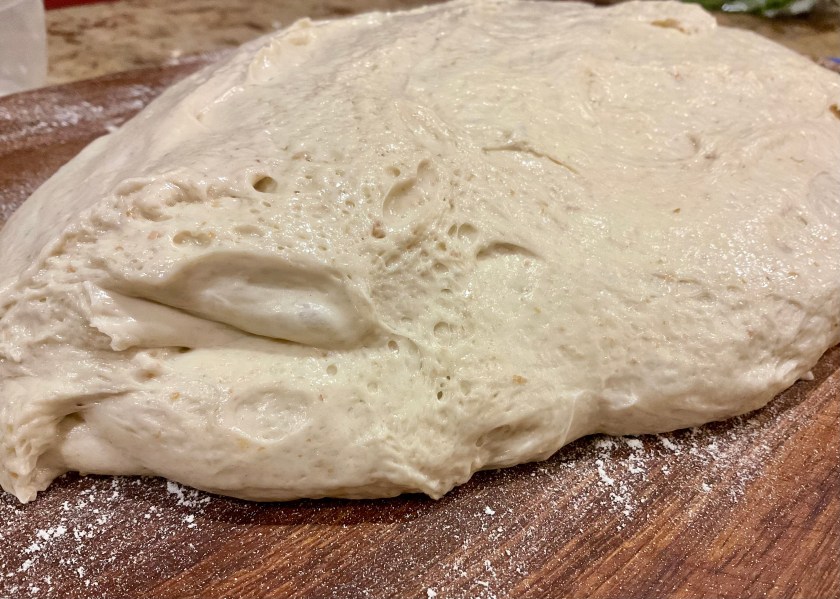
Nicely aerated dough after bulk fermentation

Preshaping (optional)
After the bulk fermentation you can go straight into the shaping, which I do for most of my sourdough, but if I have increased the water content I find I get the most reliable results if I pre-shape the dough first.
The pre-shaping helps the gluten relax just enough to make the main shaping easier to perform with a lightness of touch. Preshaping also adds extra strength to the dough and allows you to start to develop surface tension, so that when it is later turned out of its banneton, it holds its shape.
To pre-shape:
- turn the dough out onto a very lightly rice-floured surface
- rotate the dough, tucking it in gently underneath as you go* until you get a rounded dome with some noticeable surface tension – it doesn’t need much surface tension, just enough to hold its shape.
- leave this pre-shaped dough for about 30 minutes, uncovered, to allow the dough to relax a bit before shaping fully
*NB: a dough scraper, sliding it underneath the dough as you rotate, helps with this.

Bannetons
I tend to use wicker bannetons, which also give a lovely ridge to the surface of the bread.
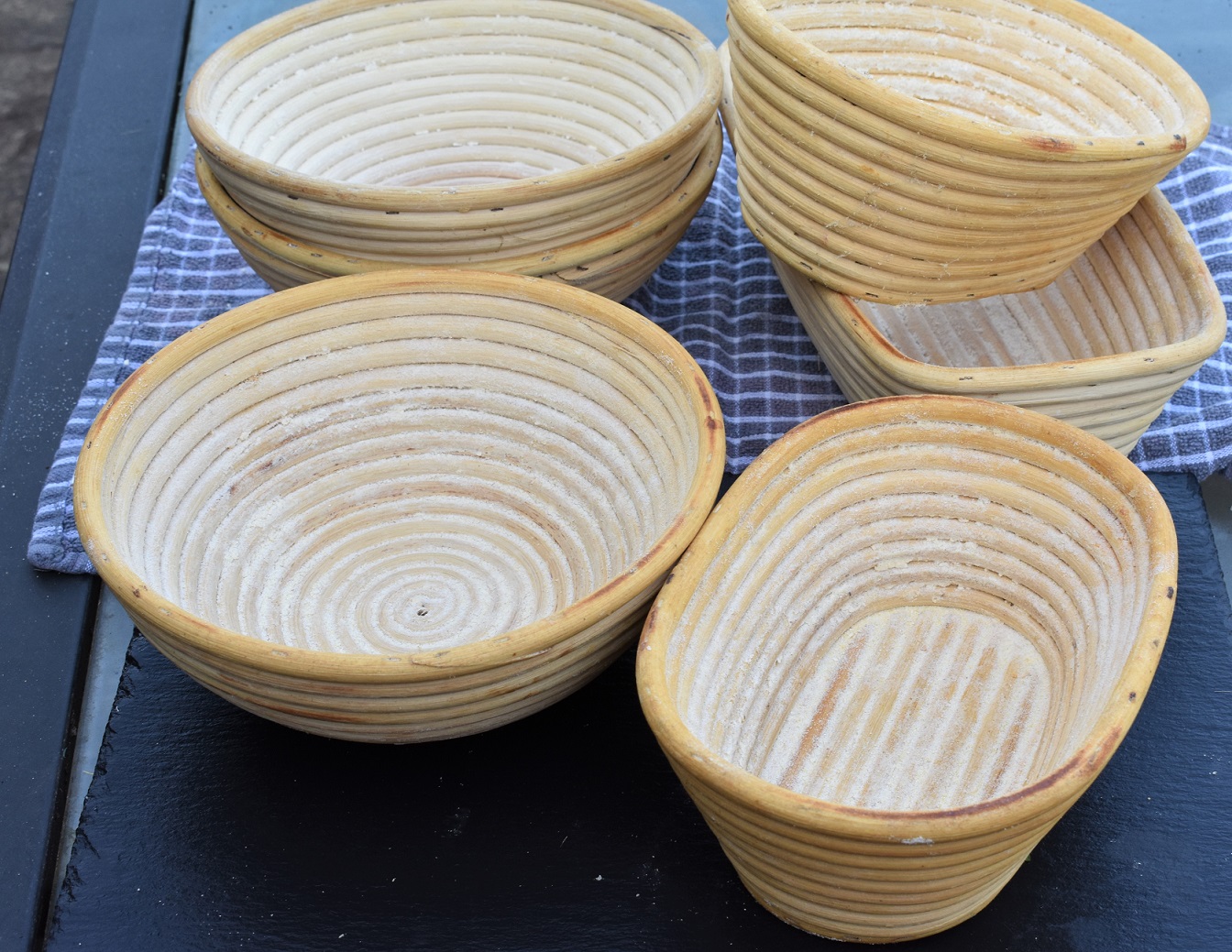
The bannetons need sprinkling generously with rice flour or fine semolina to stop the dough sticking to it. I have a container of rice flour that I also dip the shaped dough into in order to give a good coating.
If you use normal flour in the bannetons, it will absorb some of the moisture from the dough, become very sticky and make it hard to turn the dough out in one piece.

Shaping the dough
When handling the dough for shaping, aim not to deflate it too much.
If the bulk fermentation has been done well (see section above), the dough will feel light, airy and bouncy: almost like marshmallow! As you handle it, it will maintain its structure and allow you to shape it easily. Indeed, as you do this, you will notice its bounce being maintained.
An oval loaf
The two sourdoughs below were placed into oval bannetons: the one on the right was a standard oval banneton; the one on the right was a larger banneton (for which I had scaled up the recipe above to use 750g flour rather than 500g)

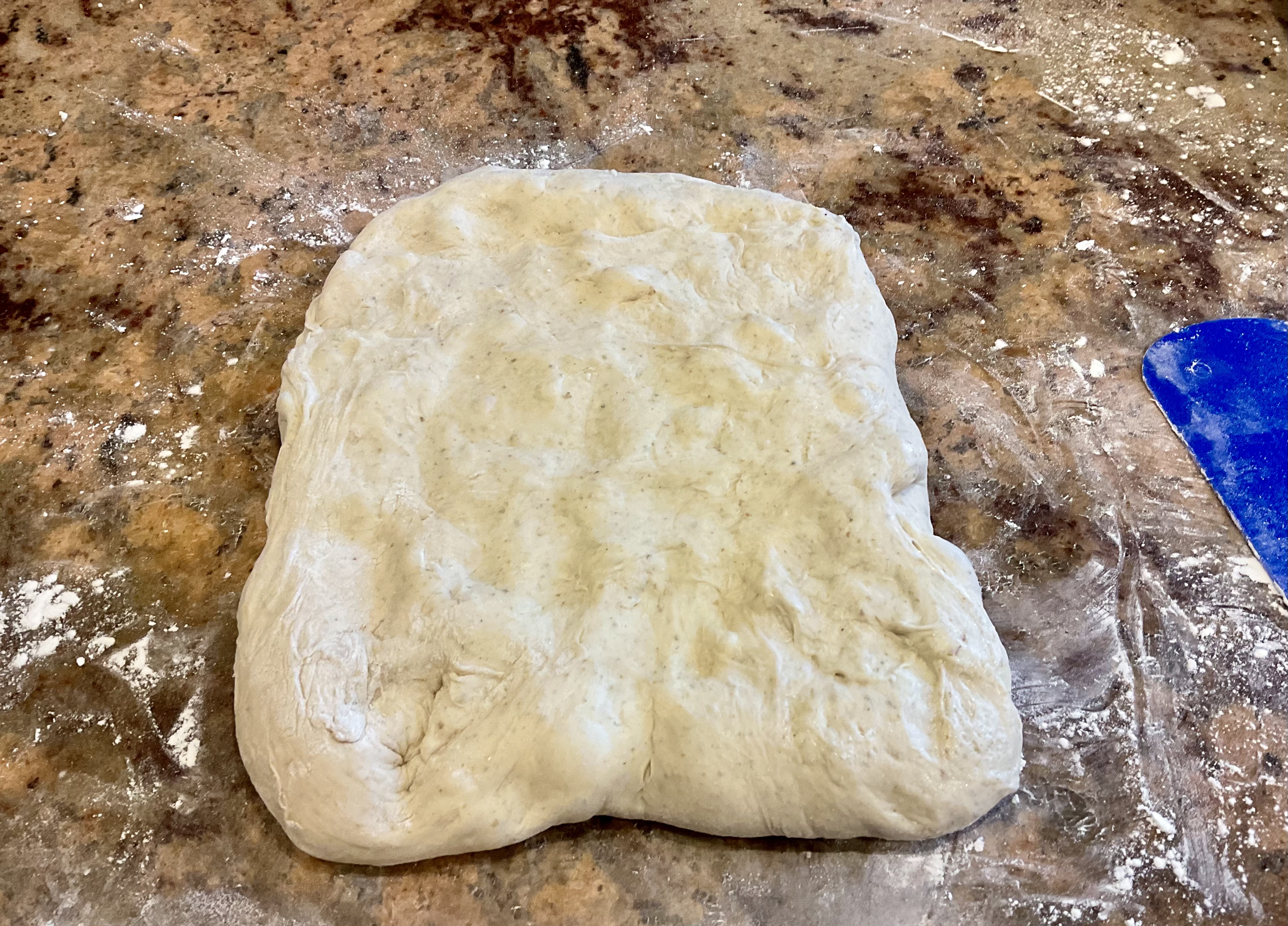
For shaping for a standard oval/rectangular loaf, you need to gently turn the dough out of the bowl and onto a lightly floured surface. I find a flexible dough scraper easiest for this.
I have included photos and instructions for each stage:
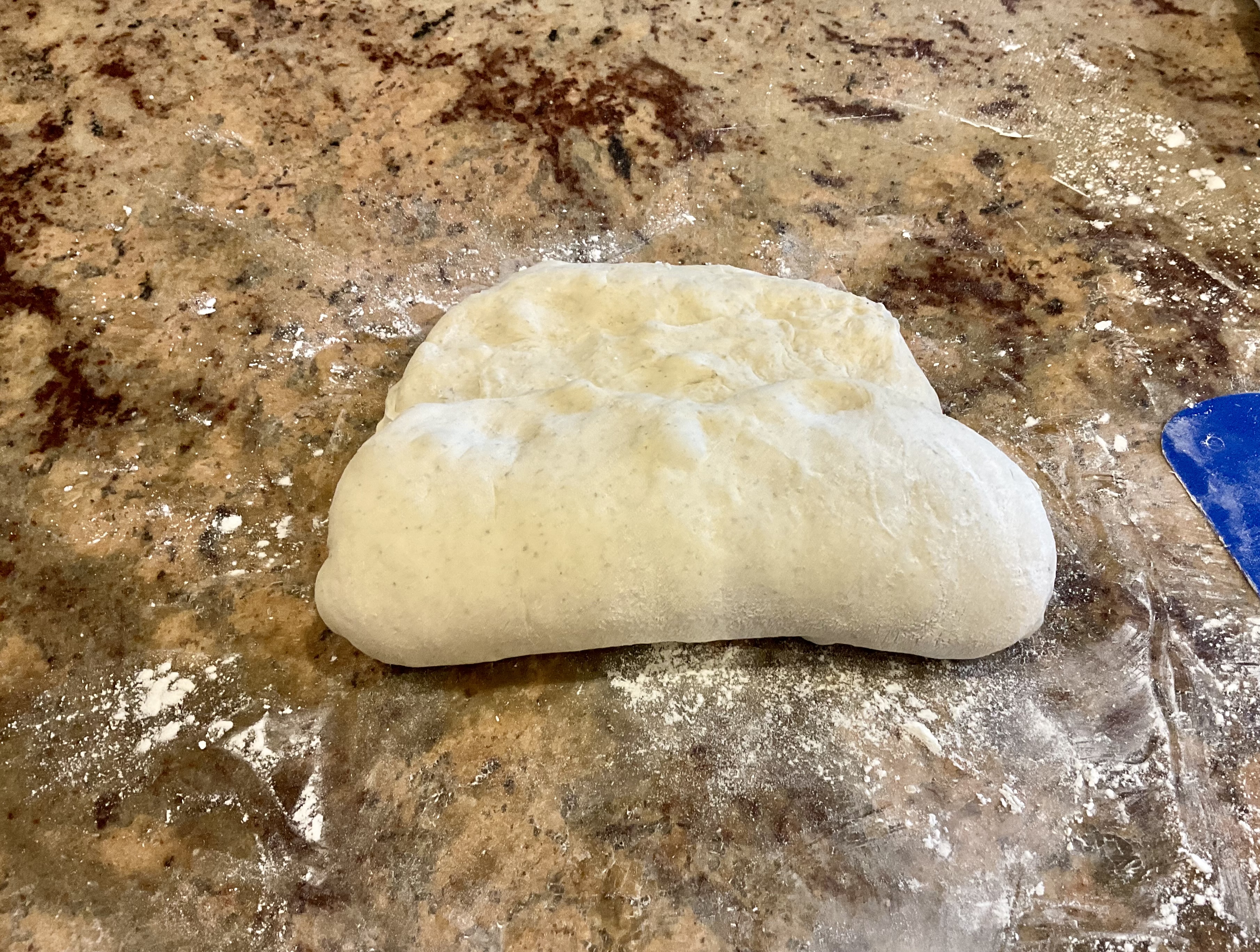

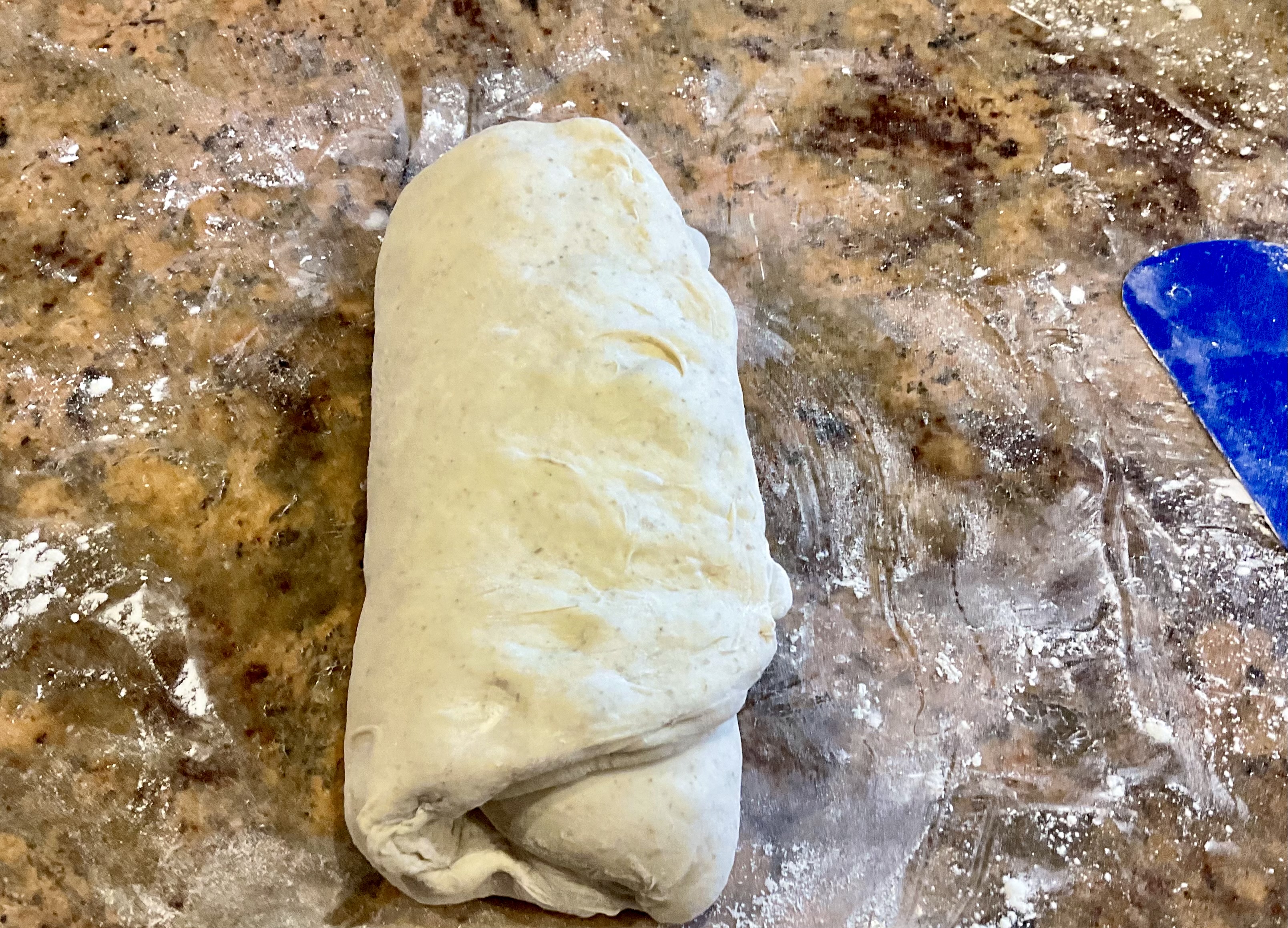
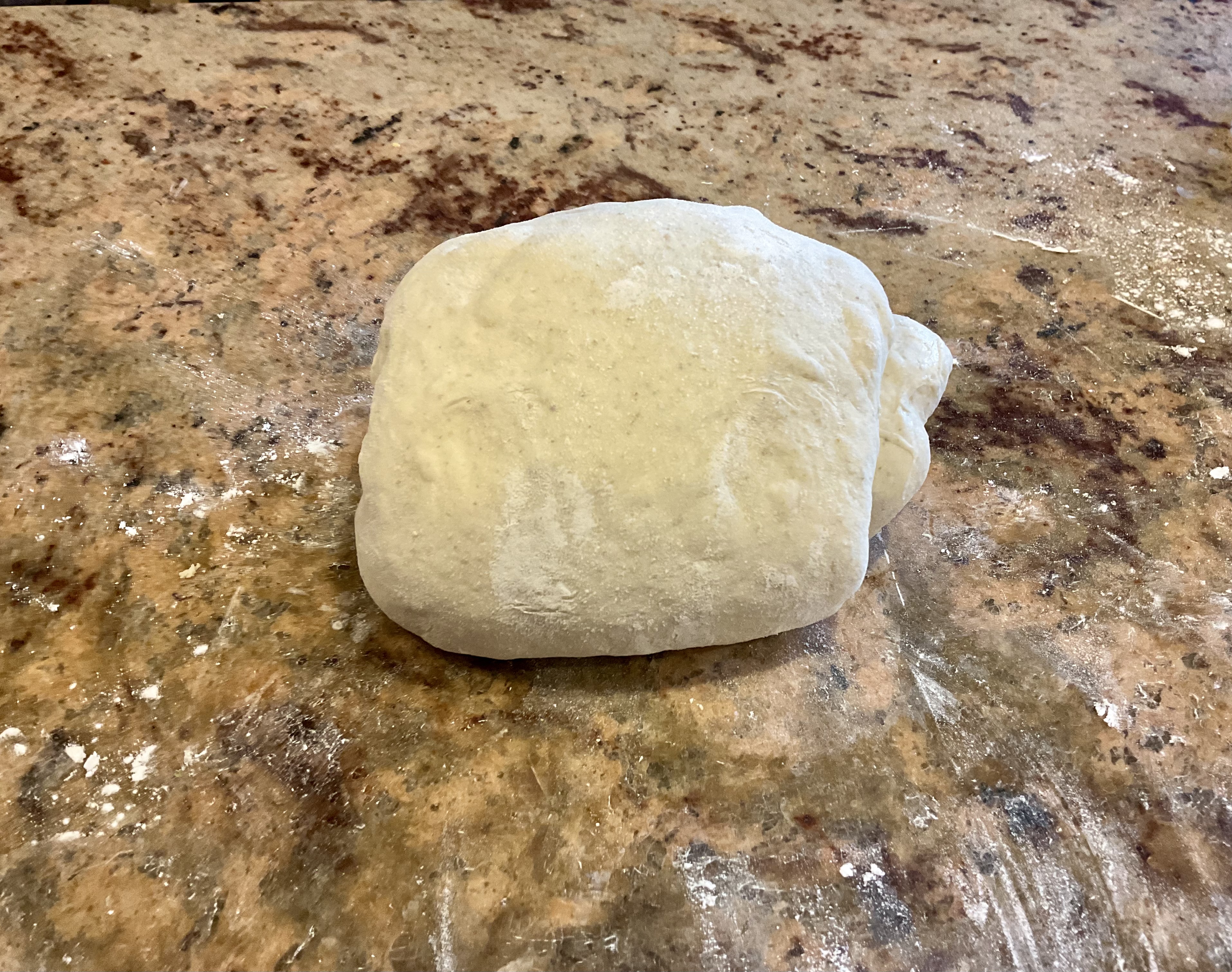
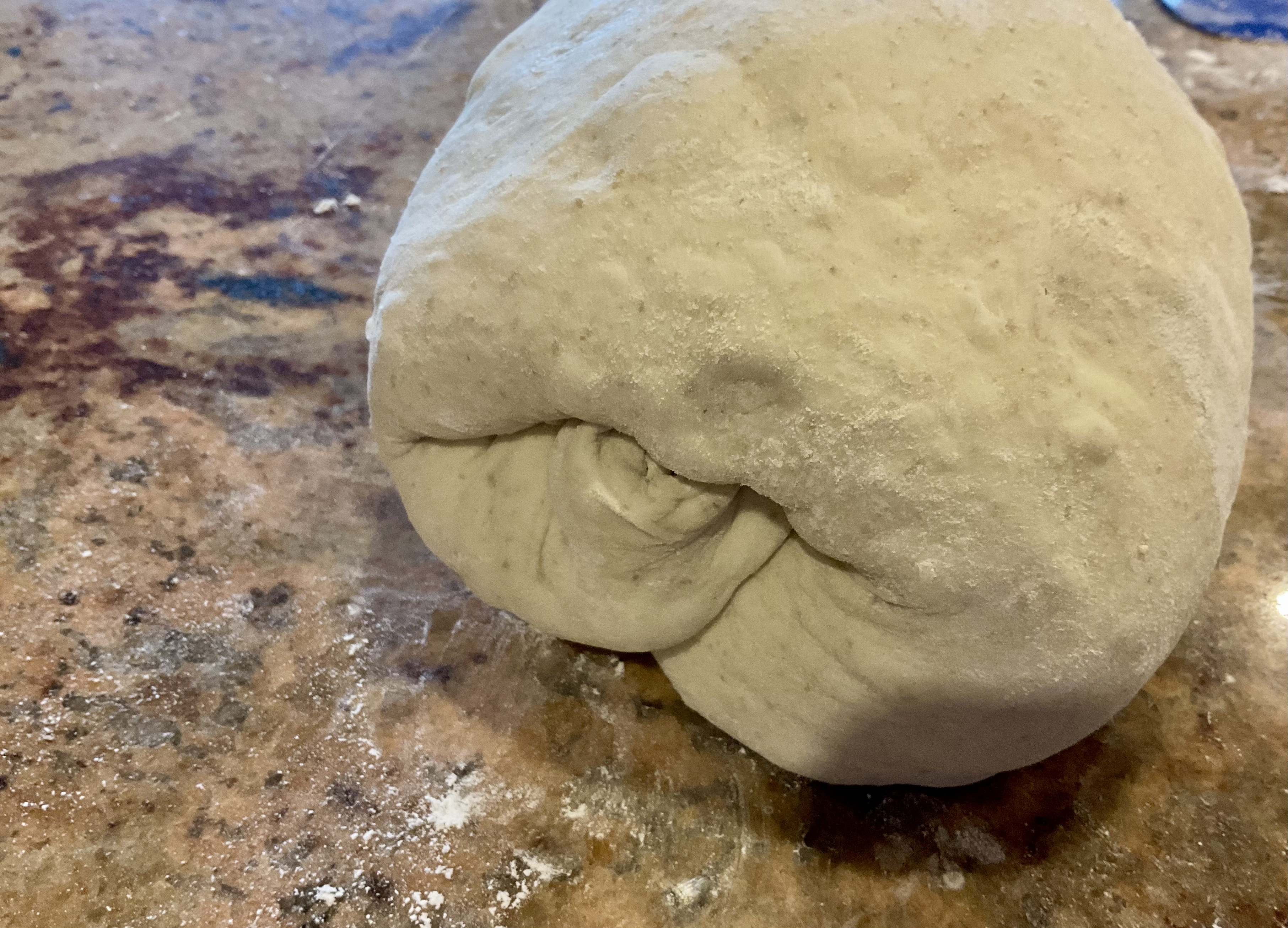
The dough is now ready to be lightly dusted with rice flour or fine semolina before being placed into the banneton, with the smooth surface facing down.

A boule
For a boule I shape as with an oval loaf, but I then cup my hands around the dough and rolling gently to form a smooth ball before popping into the banneton.
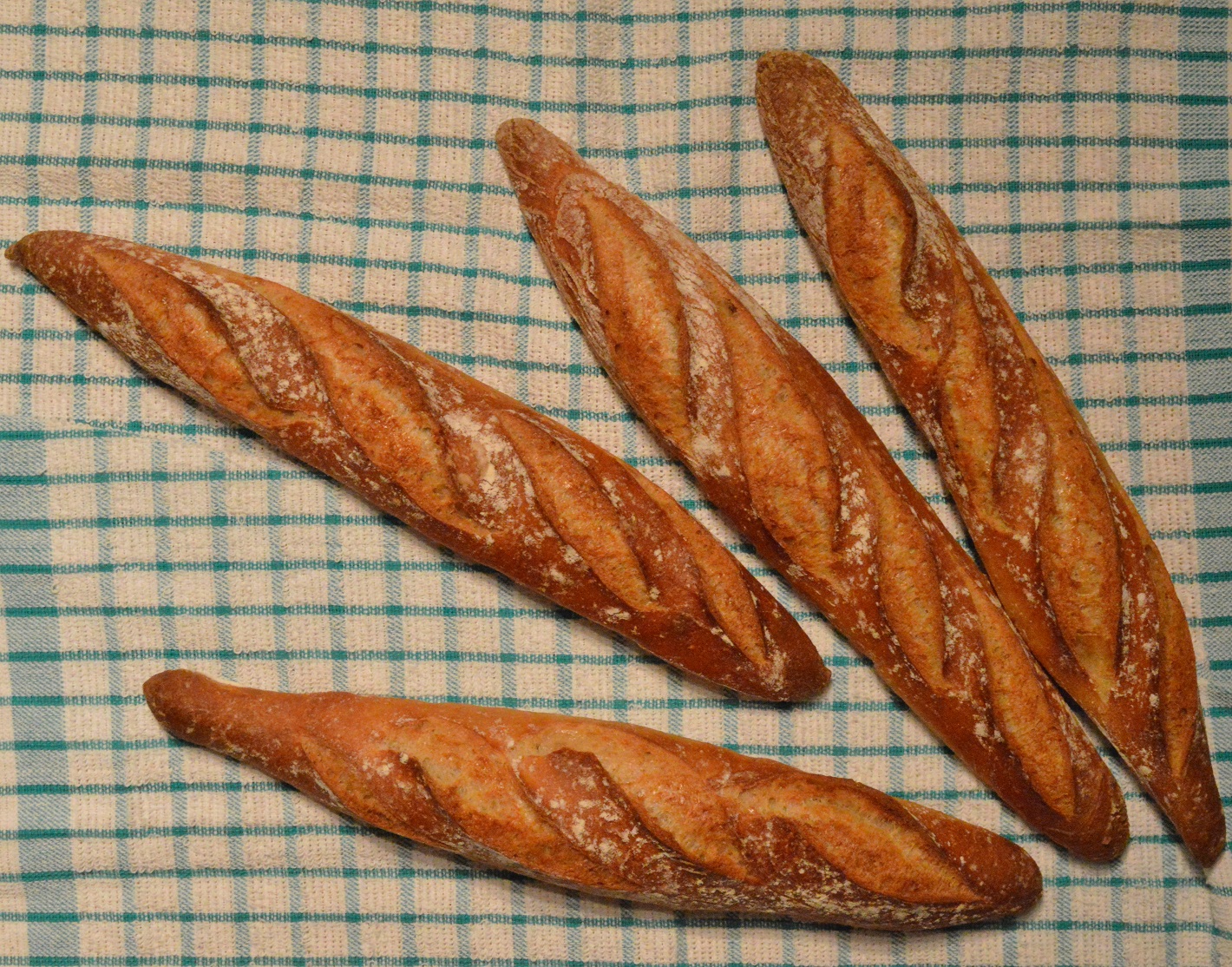
Baguettes:

- cut the dough into equal pieces.
- lightly flatten each piece into a rectangle a little shorter than the banneton or baking tray
- roll up the dough fairly tightly
- roll it gently on the work surface, putting a little more pressure at the ends to give a tapering effect.
- dust with rice flour or fine semolina
- place in baguette bannetons or baguette trays.
If using baguette trays, the shaped dough proves and bakes on the trays: I tend to place a strip of greaseproof along the trays to prevent any chance of sticking.

For bâtards (basically mini baguettes!) use a smaller amounts of the dough and shape as for baguettes.
Cold retardation: a natural flavour enhancer!
After the bulk fermentation and shaping, the dough needs to get chilled in the fridge. This is where the flavour really has a chance to develop, but it also ensures the dough is fully chilled before turning it out and scoring it: and scoring a chilled dough is much easier.
The shaped dough will rise just a little initially in the fridge, but the cold will slow down the fermentation with little danger of the dough overproofing.
You can leave the dough in the fridge for about 6 hours so that it is fully chilled all the way through. However, the longer you leave it, the better the flavour. 24 hours gives a gentle tang, but for a really tangy loaf I will go for around 36 hours.

Scoring the dough
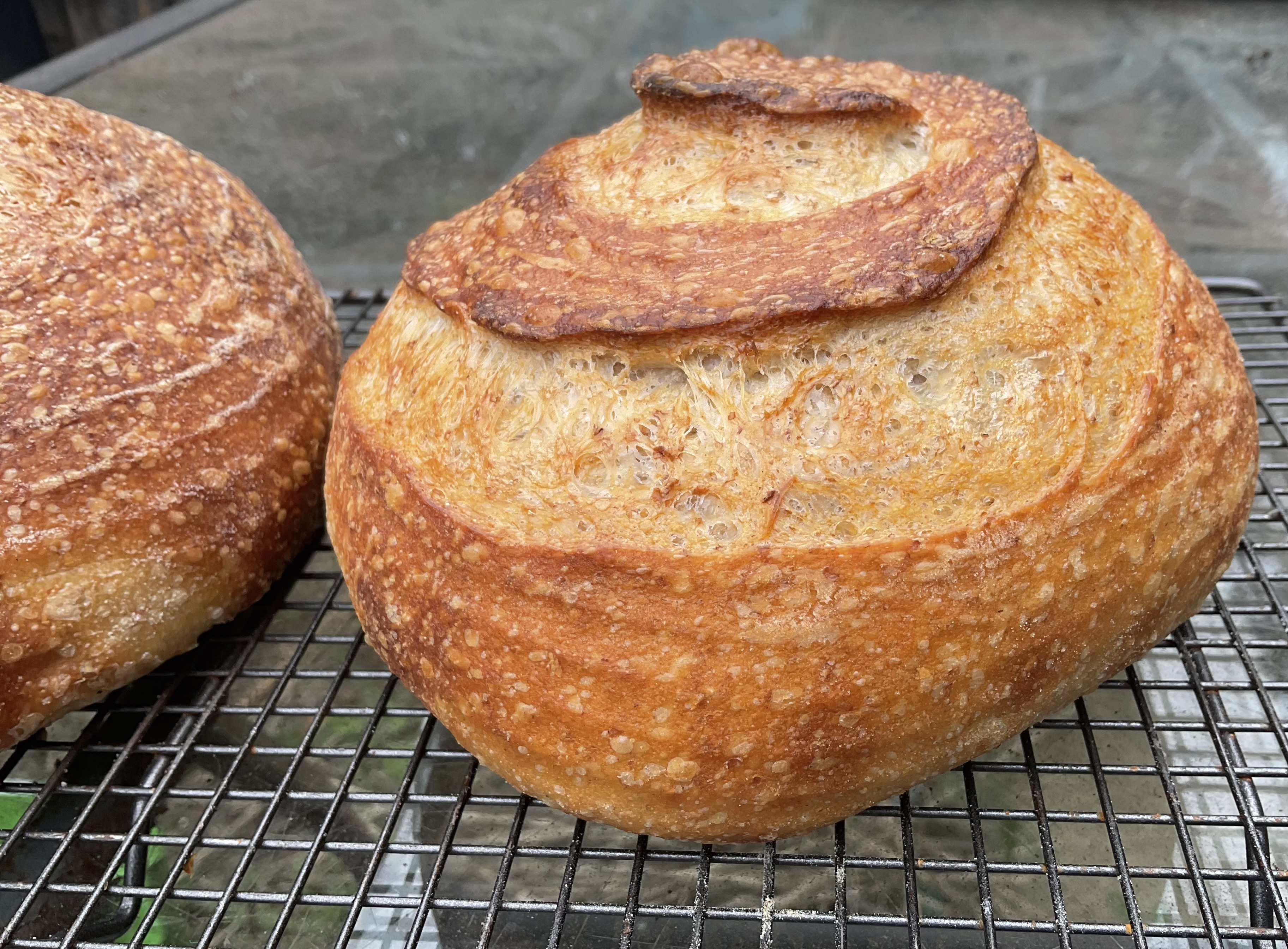
Scoring the dough allows you, to some extent, to control the direction of the dough’s expansion in the oven. Without scoring, the dough can burst at random places. Mind you, that can often look charmingly rustic.

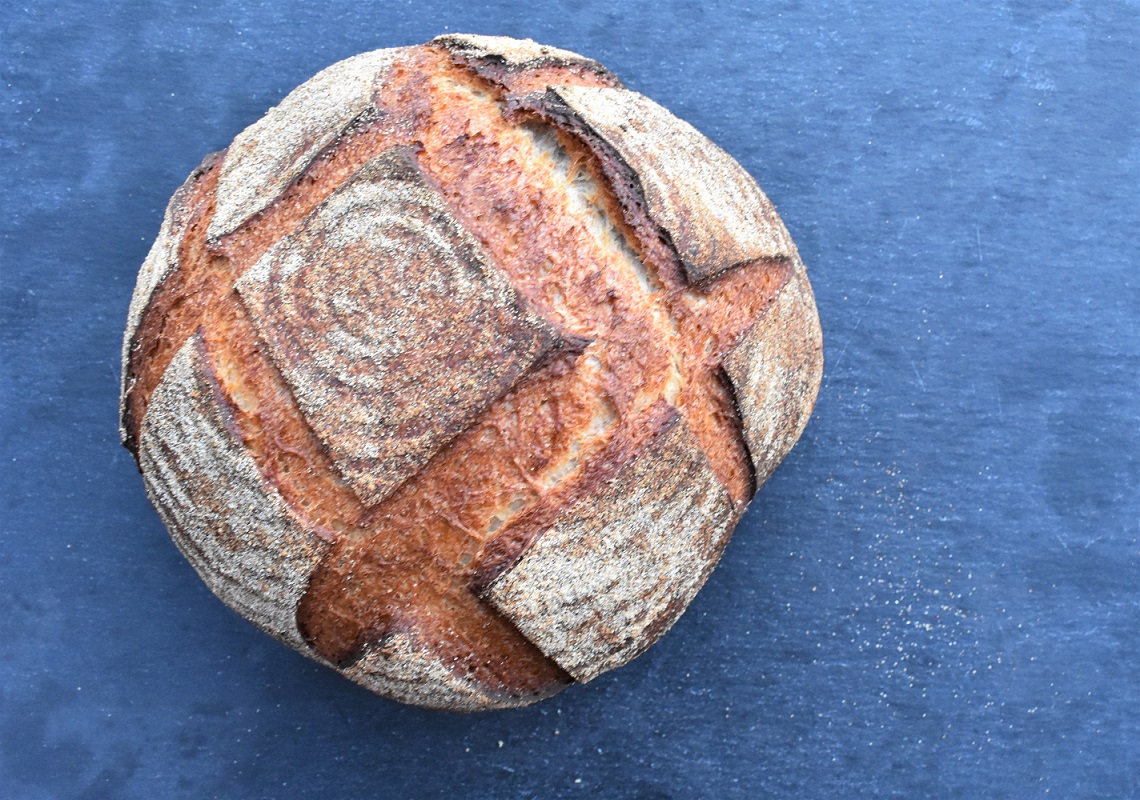
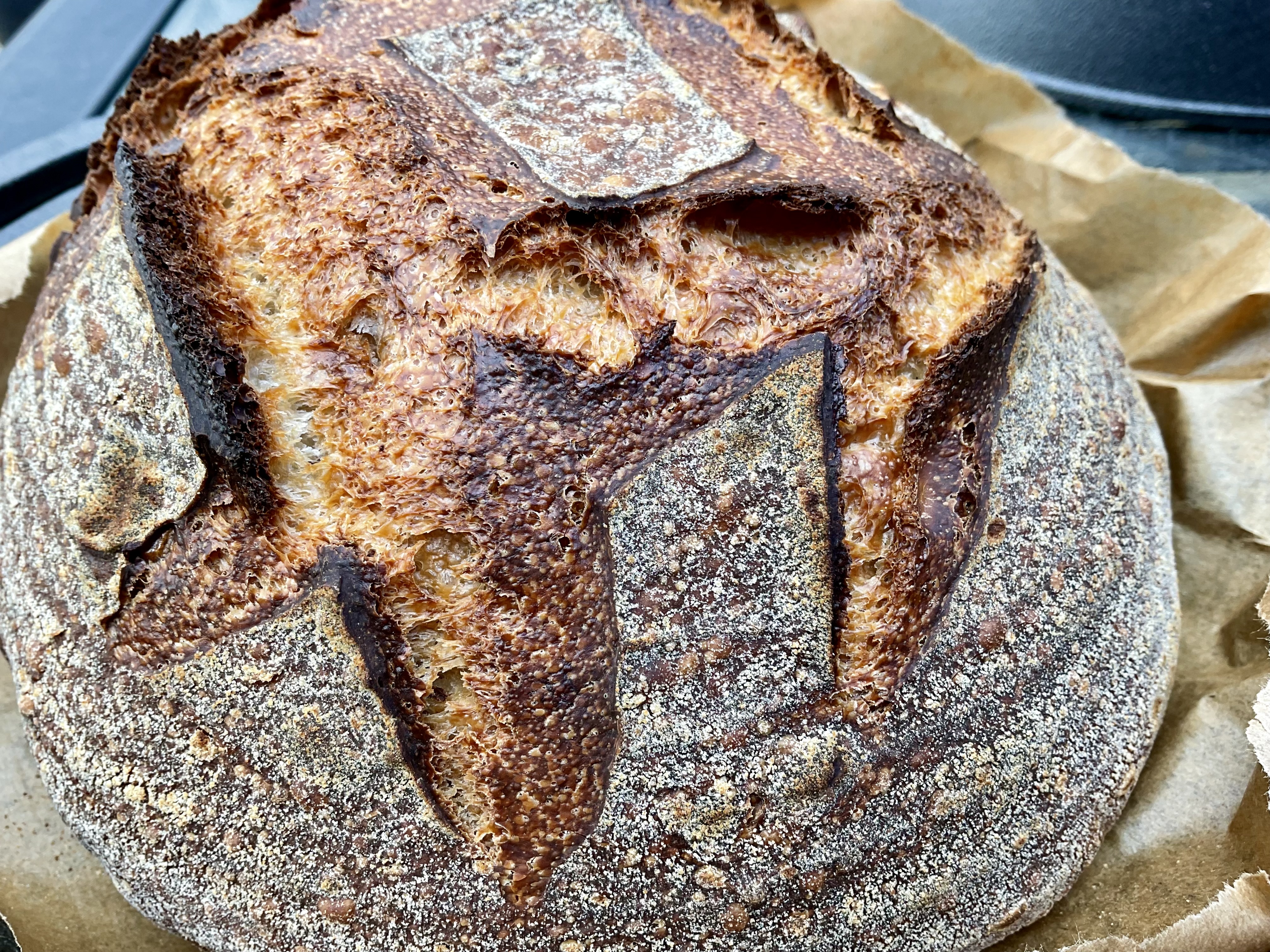
I use a razor blade making a few quick, purposeful cuts across the top of the turned out loaf, often cutting vertically and going about a centimetre in. Sometimes I simply do a quick slash in one direction, but at other times I do a few slashes crossing over.
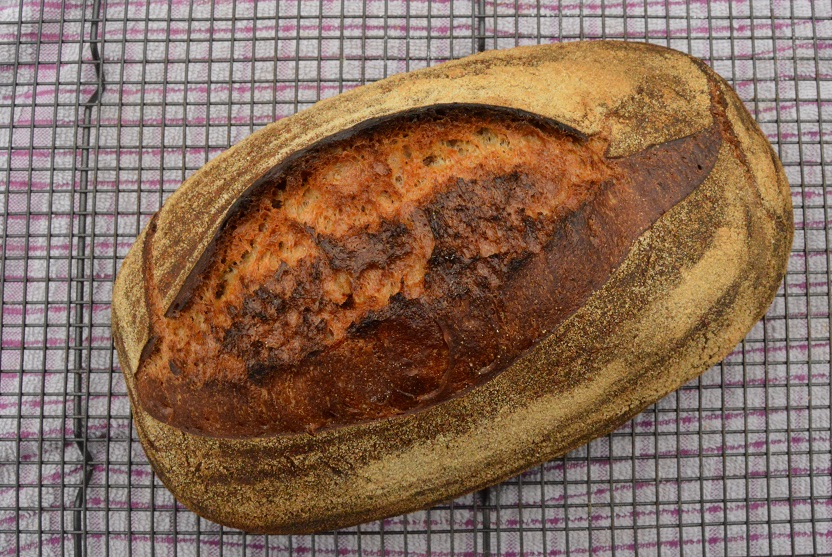
For ears I make the cut right down the far left of right side of the dough rather than down the centre of the top, going in at about 45°. This opens up the dough as it bakes – as in the loaf below.
Key scoring tips:
- a very well chilled dough is easier to score
- dust the top of the turned out dough with a little flour before scoring to help prevent tearing
- the blade has to be sharp and free of any bits of dough so that as you swipe it, it cuts quickly and effortlessly
A few of my typical scorings are in the bread below. One day I will get into more elaborate scoring but for now these suit me just fine!


To steam or not to steam
Incorporating steam when baking, both sourdough bread and bread using commercial yeast, gives the loaves the most wonderful crust. Steam also keeps the surface of the dough softer for longer in the oven so that it can keep rising: once the surface has firmed up and set, it won’t rise much more.
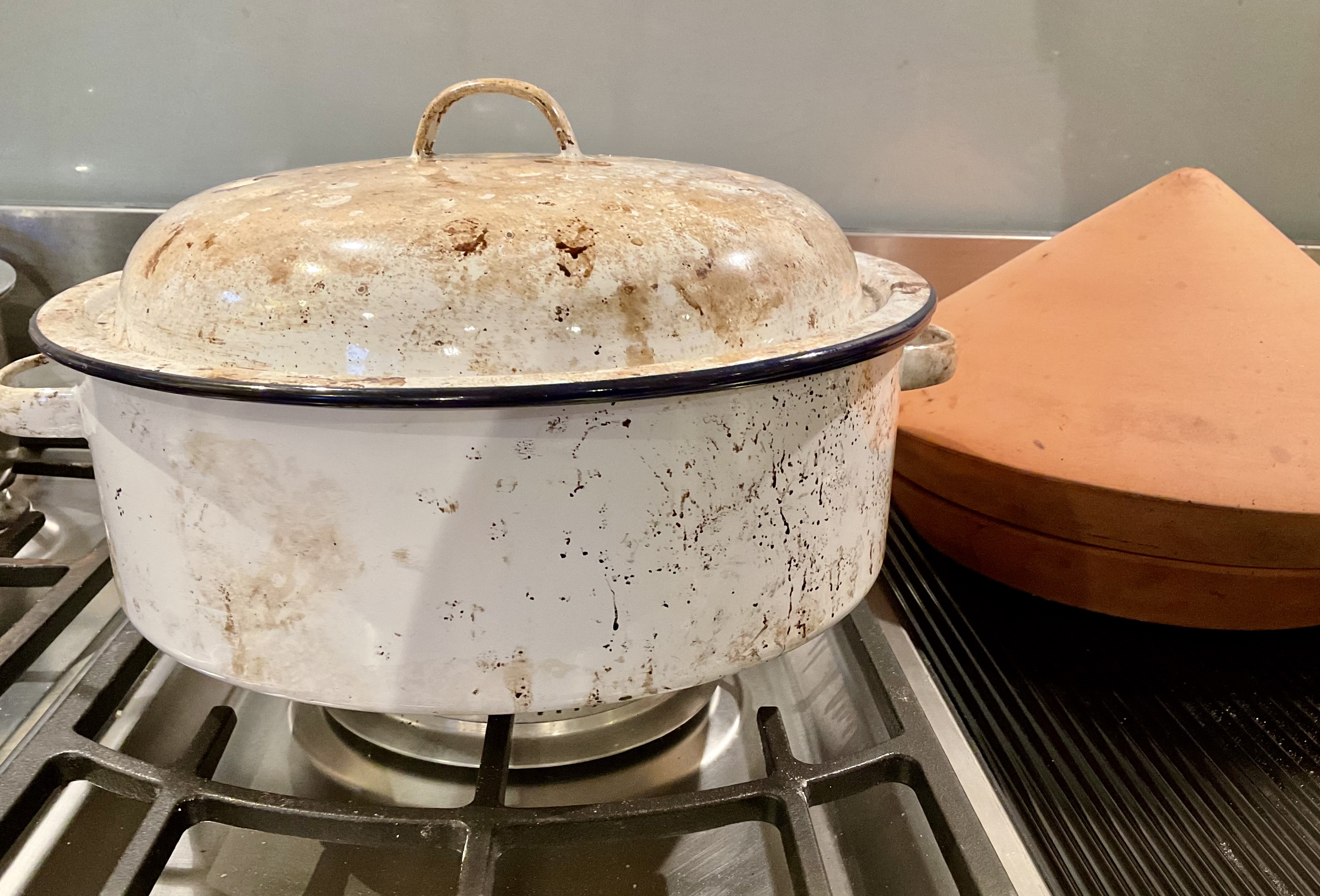
If cooking the dough in a Dutch Oven- effectively an “oven within the oven” – the steam from the dough is trapped inside so you don’t need additional water, although I like to add a few ice cubes and spray the dough liberally with water before putting the lid on to give a lovely blistering effect. The Dutch oven can simply be a cheap, aluminium casserole, a stoneware pot or a solid cast iron pan: as long as it has a lid it will work well.


Without using a Dutch Oven, there are several ways to create the steam that helps the bake. I put a solid roasting tray on the base of the oven while the oven is getting up to temperature. When I put the dough into the oven I add a few handfuls of ice cubes to create the steam and then close the door and let the dough bake. I also spray the top of the dough liberally with water.

Craving a more tangy bread?
While a sourdough loaf does not actually need to taste sour or tangy, some sourdoughs have a sour tang. This level of sourness is down to personal choice.
In the recipe above, if the chilled dough (cold retardation) has only been in the fridge for about 6-8 hours you won’t get much tang – but it will still be a delicious sourdough loaf.
For a more sour loaf:
Any of the following will work towards giving you a more sour loaf:
- stir in any clear liquid that collects on top of the starter if it hasn’t been fed for a while
- use some wholemeal or rye flour in the starter
- use less starter in the recipe, not more as you might expect. You can reduce by about a third or so and the dough will still rise, albeit more slowly (thereby developing its flavour as it produced acetic acid, which gives the tang). If you add a lot more starter, the dough will rise too quickly and not produce enough acetic acid to give a good tang.
- once the shaped dough has been proofed, leave it in the fridge for longer: 24-36 hours will give a tangier loaf.

Different flavours of sourdough
You typically add other ingredients such as cheese, onions, fruit and the like after the bulk fermentation as different ingredients can affect the fermentation of the dough. However, I often add them at the start but keep a keen eye on the progress of the dough at each stage.

- use a mix of strong plain flour and flours such as rye, wholemeal, spelt, einkorn: 400g very strong plain flour & 100g other flour is a good proportion to start with
- use a little smoked flour: I tend to oak-smoke some wholemeal or rye flour and use that. Not too much: up to 60g smoked flour to 500g unsmoked flour
- replace about half of the water with a good quality ale or cider.
- gently work roasted garlic cloves into the bread before shaping, or add these at the start with the flour so they crush throughout the dough
- add a generous handful of sultanas to the dough to give lovely sweet bursts to the finished loaf – especially when serving the bread with cheese
- add about 100g finely chopped walnuts and two grated cooking apples (peeled and cored) to the initial mixture
- work in some chopped ripe Camembert and cooled caramelised onions into the dough gently prior to shaping
- for sourdough focaccia, increase the water to about 700ml and after the bulk fermentation, gently tip the risen dough onto lined baking sheets, splash over some extra-virgin olive oil and any other flavours (rosemary, chunks of Parmesan, slices of garlic, roasted garlic cloves…..). Cover and leave to rise for a few hours at warm room temperature and bake.
- for a sweet sourdough, replace about 10% of the flour with cocoa powder, add about the same weight of caster sugar as cocoa powder to the flour before forming the dough. Gently work in about 150g of chopped dark chocolate to the risen dough before shaping. A few dried cherries (or cherries that have soaked in liqueur) or cranberries mixed into the dough is wonderful: perfect spread with salted butter!
Links to some of my favourite flavoured sourdoughs:


Beetroot & toasted walnut sourdough
Chocolate, cranberry & orange sourdough
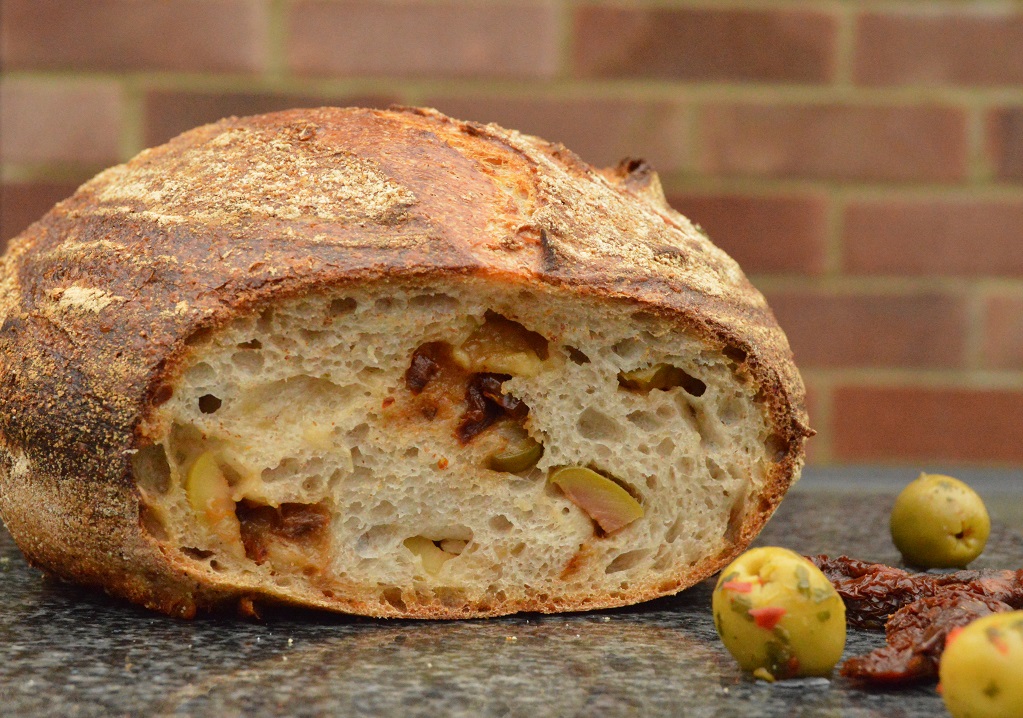
Cheese, olive and tomato sourdough
Cheese & ale sourdough
Green olive and rye sourdough
Pear, walnut & Gorgonzola sourdough loaves
Saffron and poppy seed sourdough
Other recipes using sourdough starter
The list below gives some of my favourite ways of using starter: particularly if I feel that I am storing too much starter, these are delicious ways to use some up:
20-minute sourdough flatbreads
Sourdough bagels
Sourdough crumpets
Sourdough chocolate and cherry brownies
Sourdough English muffins


However, you can simply mix in some of the starter to a normal bread dough made with commercial yeast to boost its flavour.


Thanks for all the useful hints. I often have issues with it collapsing when it comes out of the banneton so I’ll have a go at the folding and shaping before popping it in there and hopefully that will help.
LikeLike
It is so frustrating when that happens. Yes the folding/shaping should work well and you will feel it form a tight ball which signals it is ready to go into the bannetons.
Also using very heavy flouring in the bannetons – more than seems natural – gives it a light crust around the dough when turned out which also helps prevent any collapsing. Any excess flour will dust off the baked loaf
LikeLike
Thanks for that. I’ve fed “Bertie” tonight so I’ll give this a go at the weekend. Fingers crossed I avoid a frisbee this time!
LikeLike
Ah it’s not just me who names his starter..phew!
LikeLike
Reblogged this on bakingfanatic.
LikeLike
Hi,
I have been making bread using your method for years now (thanks).
Always been complemented.
Just recently I can’t make a decent loaf, they are always flat. So I have re followed the instructions here carefully this time, still flat.
What could be going on?
Thanks
LikeLike
How strange it has just happened. It might be leaving the dough too long as it proves before turning it out – so it goes too slack to hold its shape. Or even the starter is not fully active. However, you could try letting them rise and then bake in loaf tins for support
LikeLike